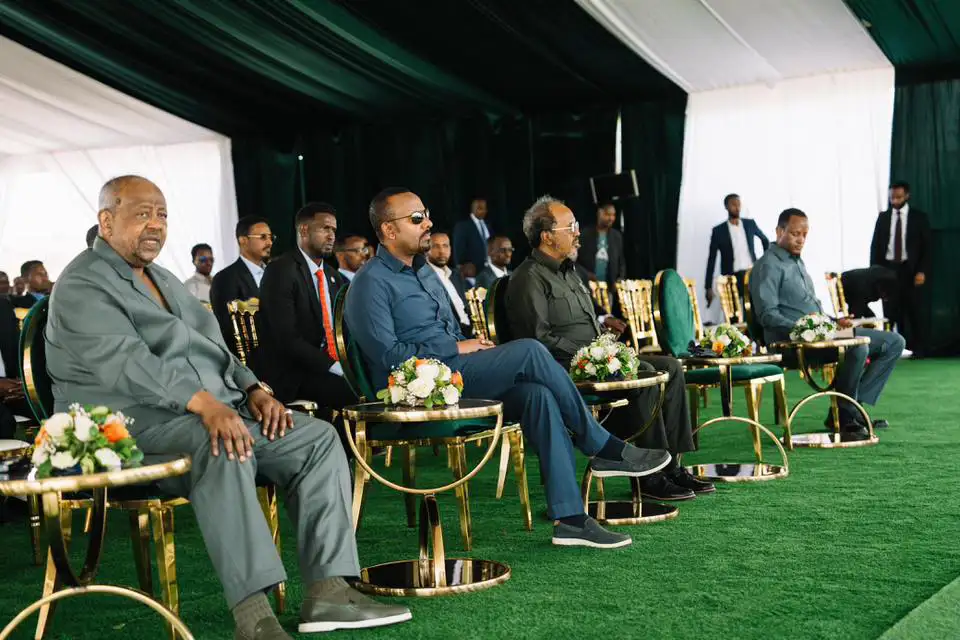
Prime Minister Abiy Ahmed has declared that Ethiopia is positioning itself to lead an impending "African era of prosperity," speaking at the high-profile inauguration of the Aisha-2 wind power project. The ceremony, attended by Djibouti’s President Ismaïl Omar Guelleh and Somalia’s President Hassan Sheikh Mohamud, served as a platform for the Prime Minister to outline a bold vision for the continent’s economic trajectory over the coming decades.
Addressing regional leaders and dignitaries, Dr. Abiy suggested that while the first half of the 21st century has been defined by the economic dominance of the West and Asia, the remaining fifty years are poised to belong to Africa. To prepare for this shift, he noted that Ethiopia is prioritising investment in early childhood education alongside massive infrastructure expansions in telecommunications, transport, and energy.
The Prime Minister underscored that Ethiopia’s industrial ambitions are tethered to environmental sustainability, pointing to the Grand Ethiopian Renaissance Dam and the newly launched Aisha-2 wind farm as evidence of a "clean energy" blueprint for the continent. This commitment to green growth has earned the country significant international diplomatic capital, with Dr. Abiy announcing that Ethiopia has been selected to host the COP32 international climate summit—a move he described as a major global endorsement of the nation’s Green Legacy and renewable energy initiatives.
Central to the Prime Minister’s message was the concept of regional interdependence. He argued that Ethiopia’s development is inseparable from that of its neighbours, pledging to deepen existing road, rail, and utility links with Djibouti while accelerating efforts to connect Somalia and South Sudan to the regional power grid. This spirit of integration, he suggested, is already yielding results through shared infrastructure with Kenya, Sudan, and Tanzania.
On the domestic front, the Prime Minister reported robust economic momentum, particularly in the agricultural sector. He revealed that the country had achieved 78 per cent of its annual agricultural production targets within the first six months of the year alone.
Concluding his remarks, Dr. Abiy framed the Aisha-2 project not merely as a national achievement but as a regional asset designed to ensure mutual benefit across the Horn of Africa. He urged neighbouring states to continue moving toward a future defined by shared resources and collective economic strength, asserting that the continent's time on the global stage has arrived.