By: Amen Biniyam
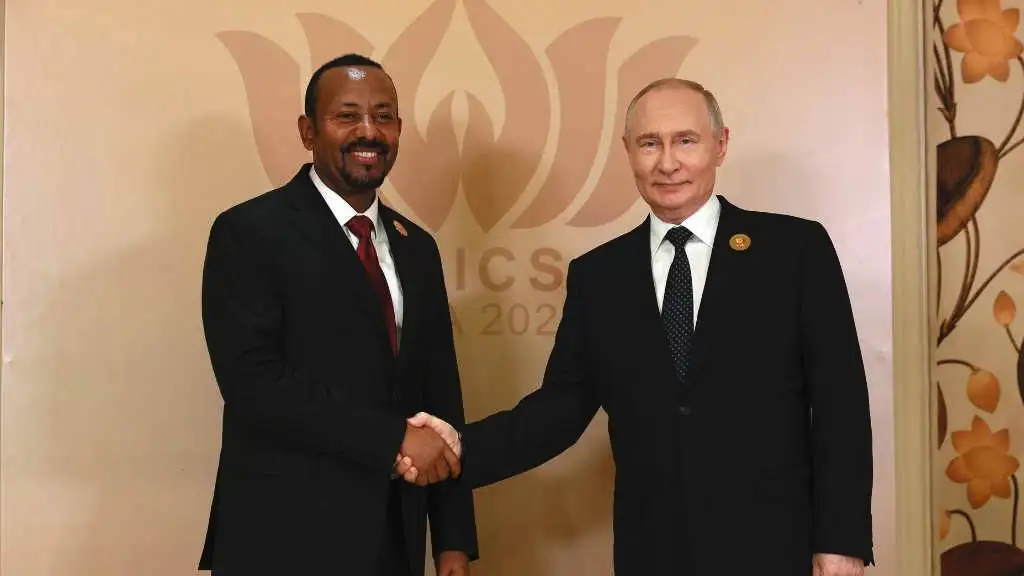
When Russian President Vladimir Putin told Ethiopian Prime Minister Abiy Ahmed that the two had "discussed almost everything" during a shared car ride to the BRICS summit venue in New Delhi, it was a small remark with a bigger story behind it: a century-old friendship that is increasingly finding new ground to grow on.
The two leaders met on September 12, 2026, on the sidelines of the 18th BRICS Summit, marking their first in-person meeting of the year. According to a Kremlin readout, the talks touched on defence and security, trade and investment, education, technology, climate and development. President Putin noted that bilateral trade had more than tripled in 2025, and invited Prime Minister Abiy to the third Russia-Africa Summit, set for October 28–29 in Moscow, where the two are expected to meet again.
The New Delhi meeting followed a visit to Addis Ababa two months earlier by Russian Foreign Minister Sergey Lavrov, his first trip to Ethiopia since 2022. Foreign Minister Lavrov met Prime Minister Abiy and Foreign Minister Gedion Timothewos, with discussions covering trade, technology transfer, energy, digital cooperation and agriculture. Both foreign ministries also highlighted the importance of coordinating positions within BRICS and at the United Nations.
Diplomatic relations between Ethiopia and Russia date back to 1898, and officials on both sides regularly describe the relationship as historic. Ethiopia's accession to BRICS in 2024 has added a new dimension to that history, giving the two countries a recurring platform for high-level contact alongside their direct bilateral channels, which include an intergovernmental commission, education exchanges, and a proposed nuclear power project being developed with Russia's Rosatom.
That nuclear project remains a work in progress. Independent analysts have pointed to Ethiopia's broader infrastructure financing needs and debt levels as factors that will shape how, and how quickly, the plan advances a reminder that translating summit-level goodwill into completed projects still depends on the details worked out afterward.
For now, both governments describe the relationship as moving from historical sentiment toward a fuller partnership one where BRICS gives Ethiopia a wider stage to coordinate with Russia and other Global South partners on the issues shaping the international order. Whether that translates into faster results on the ground is likely to become clearer at the Russia-Africa Summit in Moscow this October.
References
Africa Sustainability Matters. (2026). Ethiopia deepens Russia ties with World Trade Organisation bid and nuclear power plans. https://africasustainabilitymatters.com/
Fana Media Corporation. (2026, September 12). PM Abiy and President Putin reaffirm strategic Ethiopia-Russia partnership, expand focus on trade, education and technology. https://www.fanamc.com/
Kremlin (President of Russia). (2026, September 12). Conversation with Prime Minister of Ethiopia Abiy Ahmed. http://en.kremlin.ru/events/president/news/80749
Ministry of Foreign Affairs of Ethiopia [@MFAEthiopia]. (2026, July 7). Minister of Foreign Affairs, Gedion Timothewos, held talks with the Minister of Foreign Affairs of the Russian Federation, Sergey Lavrov [Post]. X. https://x.com/MFAEthiopia/status/2074501973307470124
TASS. (2026, September 12). Putin meets with Ethiopian prime minister in New Delhi. https://tass.com/politics/2186733
The Reporter Ethiopia. (2026). Nuclear scientist cautions against Ethiopia's newfound atomic ambitions. https://www.thereporterethiopia.com/47822/