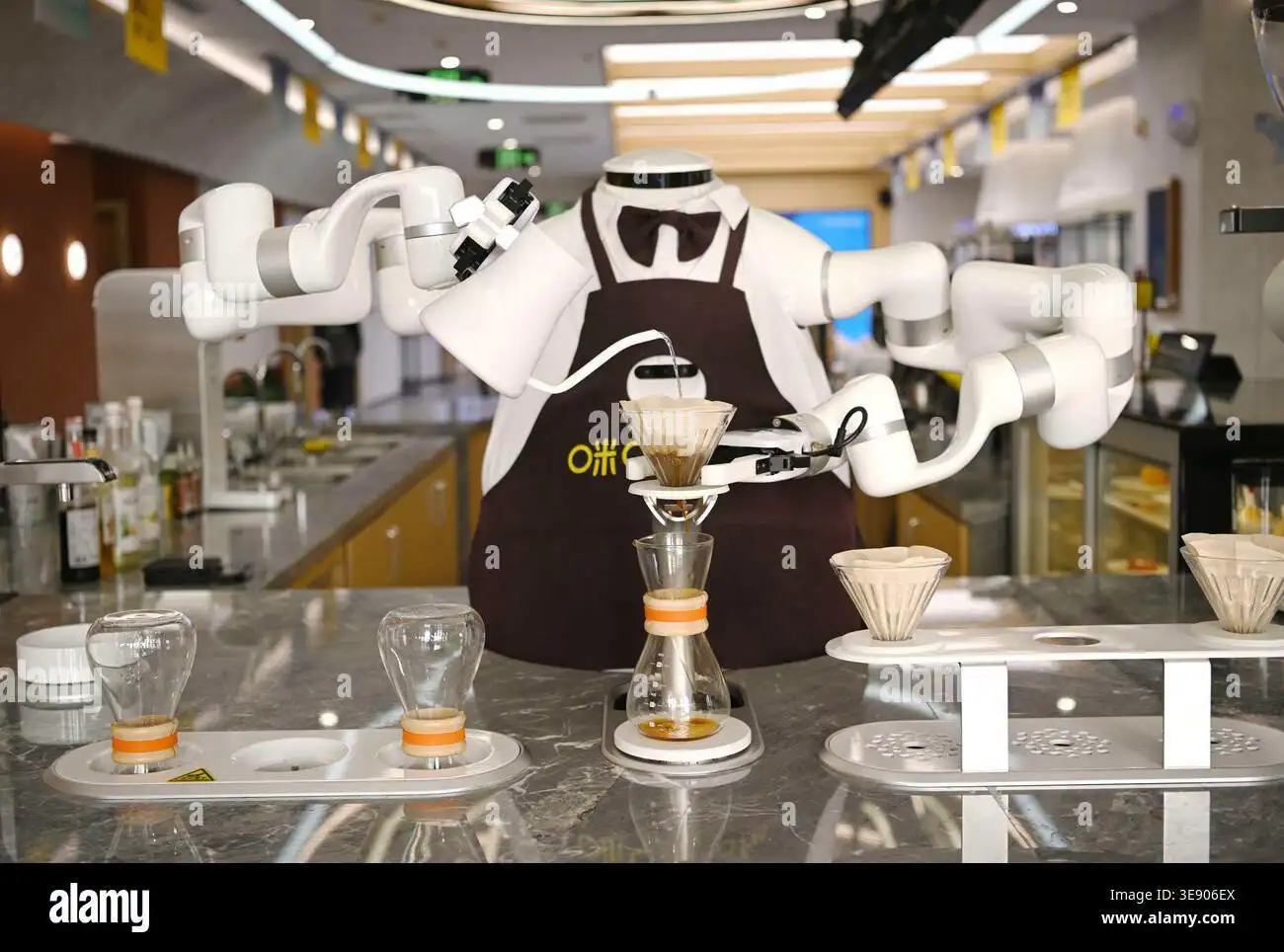
Anyone witnessing the robot in the Chinese city of Kunshan artfully brewing Ethiopian coffee without human assistance, or learning of the artificial heart beating flawlessly inside a human chest for the past eight years, is compelled to ask a single question: What is the ultimate destination of human technological advancement?
Admittedly, asking such a question might sound like ordinary tech chatter or the premise of a fictional "what if" scenario. However, because we are living in a historical epoch where human life and cultural history are actively being rewritten by the Artificial Intelligence (AI) revolution, this becomes a profoundly real question. So, let us explore it.
The traditional Ethiopian coffee ceremony is no ordinary daily routine; it is the firm pillar of our social fabric, possessing a profound charm that words can hardly describe.
The aroma of raw coffee beans roasting over glowing red embers, the rhythmic thud of the mortar beating like a heartbeat, the wafting smoke of frankincense, and the "black gold" slowly pouring from the darkened clay jebena (pot) into the cups—all these elements combine to create a deeply rooted Ethiopian culture that has preserved human interaction, togetherness, and social bonds for centuries.
Therefore, watching this deeply spiritual and human-centered Ethiopian tradition being performed by a metal robot in Kunshan—a city in China’s Jiangsu province, thousands of kilometers away from Addis Ababa—was an incredibly astonishing and mesmerizing spectacle.

Recently, as part of the "Belt and Road" Journalists' experience-sharing tour, I found myself in a hyper-modern building illuminated by neon lights, at what is hailed as the world's first robotic retail shop, the "Robot 6S Store." There, I watched a highly advanced Artificial Intelligence (AI) robotic arm flawlessly grind, prepare, and brew premium Ethiopian coffee, completely without human assistance.

This fusion of an African agricultural product and China's advanced robotics engineering is a monumental event. Distinct from the conventional digital models often seen in the Western world today, it clearly demonstrates the massive strides China is making globally in the fields of robotics and artificial intelligence.
However, China’s technological prowess and the greatest lessons we can draw from it are not limited to retail and robotics. The true miracle of China's technological leap lies in its monumental contribution to saving human lives.
Eight years ago, utilizing highly sophisticated medical engineering, Chinese scientists and surgeons successfully implanted a domestically developed, fully functional Artificial Heart into a 60-year-old man suffering from end-stage heart failure.
Powered by complex AI algorithms that flawlessly monitor and mimic the rhythm of a human heartbeat, this artificial heart not only saved the man's life but has also enabled him to live in stable health today, eight years later.

China is utilizing AI in the healthcare sector extensively and with great success. This advanced engineering is the path through which it has ensured its digital sovereignty, mitigating the shortage of medical professionals in its hospitals and saving lives.
This overarching Chinese technological advancement offers a profound lesson for Ethiopia’s digital destiny. Yet, Ethiopia is not sitting back with folded hands, waiting for these modern solutions to be imported.
Established as the first dedicated government AI institution in sub-Saharan Africa, the Ethiopian Artificial Intelligence Institute (EAII) is following in China’s successful footsteps, actively building our own medical solutions using homegrown expertise.
In partnership with the Ethiopian Public Health Institute (EPHI), local engineers have successfully developed AI models designed to detect breast cancer from mammography images and to classify types of diabetes. They are also currently testing models that can detect deadly heart diseases directly from ECG signals.
China has reached this level of excellence in the AI technology sector not just because of the hardware it has built, but also because of the incredibly strong ethical philosophy by which it governs the technology.
Professor Zheng Changzhong, a renowned scholar at Fudan University, describes China's foundational tech ethics governance using a profound metaphor: “fastening the first button.”
"If you misalign the very first button on a shirt, every subsequent button will be crooked," Prof. Zheng explains.
Similarly, as Ethiopia advances its "Digital Ethiopia" strategy, it has begun to correctly "fasten its own first button" and prepare technological ethical frameworks by drawing on the experiences of nations with rich expertise in the field, like China.
 True technological ownership and digital sovereignty are unthinkable without physical infrastructure. Without your own data centers, high-speed internet connectivity, and massive computing power, you cannot fully own the technology.
Recognizing this massive challenge, Ethiopia is aggressively building its own computing backbone, absorbing lessons from China's infrastructure development experience.
The AI Institute has deployed a massive Tier-3 Data Center boasting 99.98% reliability, 15 Petabytes of data storage, 13,000 computational virtual machines, and 8,000 GPUs. Furthermore, in collaboration with the Wingu Africa commercial data center built in Addis Ababa, we are now securely hosting our own data within our own reliable facilities.
As artificial intelligence and robotics advance at breakneck speeds, anxieties regarding job losses inevitably arise. Addressing this concern, Professor Zheng offers highly encouraging advice: "We must not give up eating for fear of choking."
Just as China has done, we must transition our youth from merely being consumers of technology to becoming active AI creators. Through the EAII Startup Center and the recently launched, UNDP-backed "AI UniPod," over 200 young homegrown innovators are currently developing and scaling their own solutions.
Watching a robotic arm brew Ethiopian coffee in the city of Kunshan is undoubtedly a magnificent masterpiece of modern Chinese engineering. Similarly, the Chinese artificial heart beating inside the chest of a 60-year-old man is a scientific miracle and a manifestation of the immense potential technology holds when dedicated to human well-being.
As I drank the coffee brewed by that robot, one thing became crystal clear to me: technology can flawlessly execute a process, but it is humanity that must determine the ultimate purpose and meaning of that technology.
The successful AI and robotics experience China has accumulated, its wisdom in technological governance, and its focus on human welfare have cast a bright guiding light on Ethiopia’s digital journey.
At a time when our own data centers are operational, our institutions are improving public health and saving lives, and our youth are writing algorithms in indigenous languages, Ethiopia is drawing lessons from Chinese excellence to build its digital economy on a solid foundation.
By further deepening our Ethio-China partnership, we will make our shared, bright digital destiny a reality.
By Nebiyou Wondwosen