
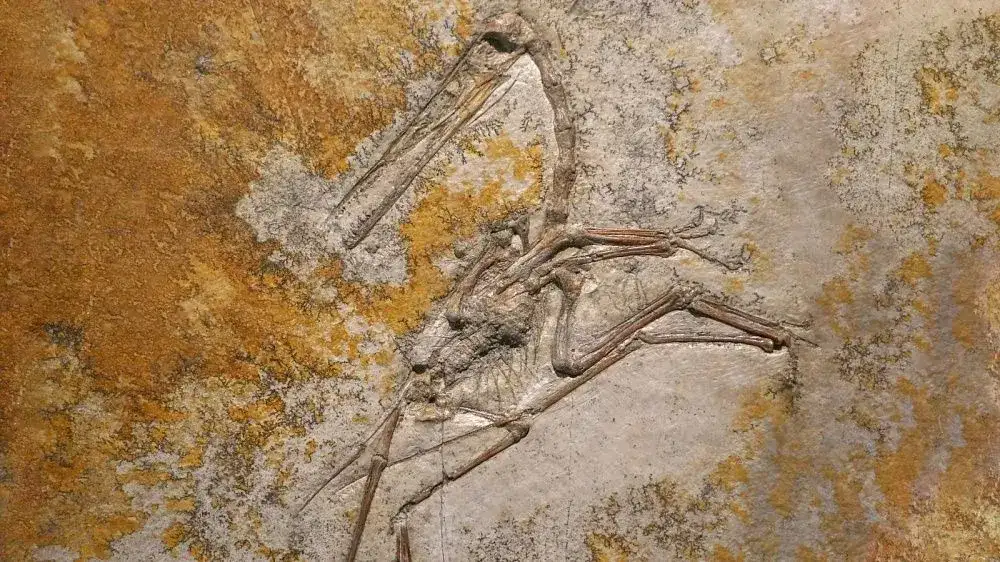
Scientists from the Chinese Academy of Sciences have uncovered a well-preserved ancient bird fossil in Fujian Province that provides new insights into how birds evolved from having long tails to the short structures seen today.
This discovery addresses a long-standing evolutionary debate by clarifying the sequence of tail changes. While early birds and dinosaurs possessed long tails often exceeding their body length, modern birds feature a short tail ending in a pygostyle, a specialized structure of fused vertebrae used for balance and flight.
Research confirms that the tail shortening occurred before the vertebrae fused, as the fossil exhibits a noticeably shorter tail with roughly 15 vertebrae but lacks the fused pygostyle. This transitional stage helped improve flight maneuverability by shifting the center of gravity.
Furthermore, TV Brics reports that the bird's small size, measuring about 20 centimeters, indicates rapid adaptation to arboreal life and active flight. The find was located in a region rich with diverse avian fossils from the late Jurassic period, further suggests that early bird evolution was not linear but occurred along multiple paths simultaneously.