
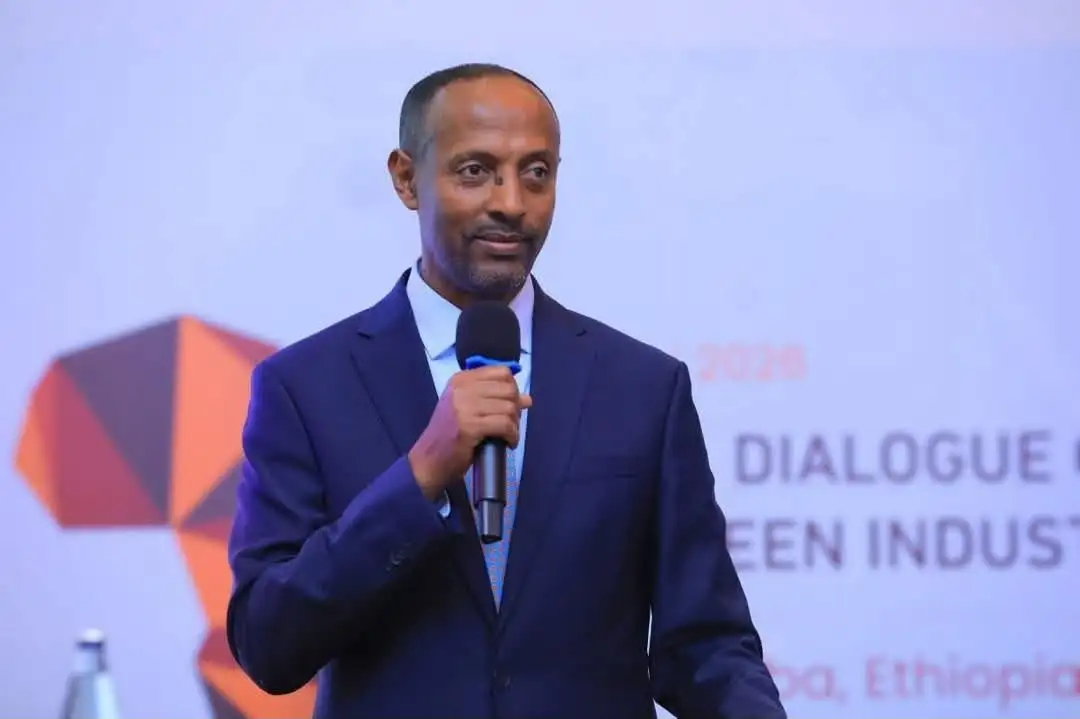
Ethiopia’s Minister of Industry, Melaku Alebel, told delegates at the “Africa Dialogue on Cement for Green Industrialisation” in Addis Ababa that the continent must seize a narrow window to shift infrastructure growth onto low‑carbon pathways, urging governments, manufacturers and development partners to accelerate carbon‑free technologies, sustainable fuels and coordinated policy support ahead of COP32.
Minister Melaku said the three‑day continental forum — attended by 110 participants from 42 countries — is designed to turn Africa from a climate victim into a global provider of green development solutions, and he recommended immediate steps on energy sourcing, feedstock substitution and fiscal incentives to scale zero‑carbon cement production.
Speaking during the occasion, the Minister, warned that Africa faces a make‑or‑break moment as studies show “80 per cent of the infrastructure that will exist by 2050 is yet to be built,” and therefore “driving demand with carbon‑free technology is a matter of survival,” he told the assembled ministers, industry representatives and technical experts.
“This forum is a great platform for Africa to move from being a victim of climate change to being a green development solution provider for the global community,” the Minister said, calling for continental cooperation on standards, finance and technology transfer.
Detailing Ethiopia’s green industrial credentials, Melaku reported that many domestic factories now run on hydroelectric power and that, with the Grand Ethiopian Renaissance Dam bolstering generation, the national grid is “close to 100 per cent clean energy,” a claim he presented as evidence of the feasibility of low‑carbon manufacturing. He said Addis Ababa’s wider environmental efforts — including a national tree‑planting drive — underpin the country’s ambition to decouple industrial growth from emissions. “We have planted over 48 billion trees since 2011, and we are on track to plant another eight billion,” he added, urging peers to replicate integrated nature‑based measures alongside technological shifts.
On practical pathways, the Minister outlined actions Ethiopia has taken and recommended for the region: replacing coal with agricultural waste and biomass as kiln fuels; providing fiscal incentives to manufacturers engaged in green production; scaling electric vehicle adoption following a national ban on fossil fuel vehicles; and aligning industrial strategy with climate commitments to present a united African position at COP32 in 2027, which Ethiopia will host. “Together, we will build a greener continent for future generations by aligning our production capacity with climate responsibility,” Melaku underscored.
Technical and financial partners at the forum stressed the urgency of coordinated policy frameworks and investment vehicles that de‑risk private finance for cleaner cement technologies, such as electric kilns, alternative binders, and carbon capture, where feasible. Participants agreed to draft a set of regional recommendations on harmonised emissions metrics, shared procurement approaches to lower upfront technology costs, and pilot projects to demonstrate commercially viable low‑carbon cement supply chains, it was noted.
Furthermore, organisers said the forum will culminate in a policy brief and an action plan aimed at governments, industry associations, and multilateral financiers, and will seek to launch cross-border pilot initiatives in selected production hubs.
The Minister went on to urge attendees to translate dialogue into concrete commitments, recommending a road map for technology transfer, tariff and tax reforms to reward low‑carbon production, and a collective African pledge at the 2027 UN Climate Change Conference to showcase the continent’s green industrial transition.