From the ancient rock-hewn churches of the northern highlands to the lush landscapes of the south, Ethiopia illuminated the night sky this weekend to celebrate Meskel. Marking the historic discovery of the True Cross, this majestic festival is one of the most profound spiritual traditions of the Ethiopian Orthodox Tewahedo Church. It honors the ultimate crown of victory that guided humanity out of deep darkness and into wondrous light, drawing millions of locals and global tourists into a sweeping display of faith, heritage, and communal renewal that echoed through every region of the country.
The historical and spiritual foundation of this vibrant celebration rests on Queen Helena’s relentless quest to uncover the hidden resting place of the cross on which Christ was crucified. Her journey to Jerusalem was grueling and fraught with the harsh trials of her era. Yet, sustained by fasting, prayer, and profound patience, her unwavering faith kept her entirely focused on her pursuit of truth. Her exhausting search finally bore fruit when she lit a fragrant bonfire, known as the Demera. Miraculously, the rising smoke drifted to pinpoint the exact location of the buried cross, securing a monumental victory for the steadfast queen.
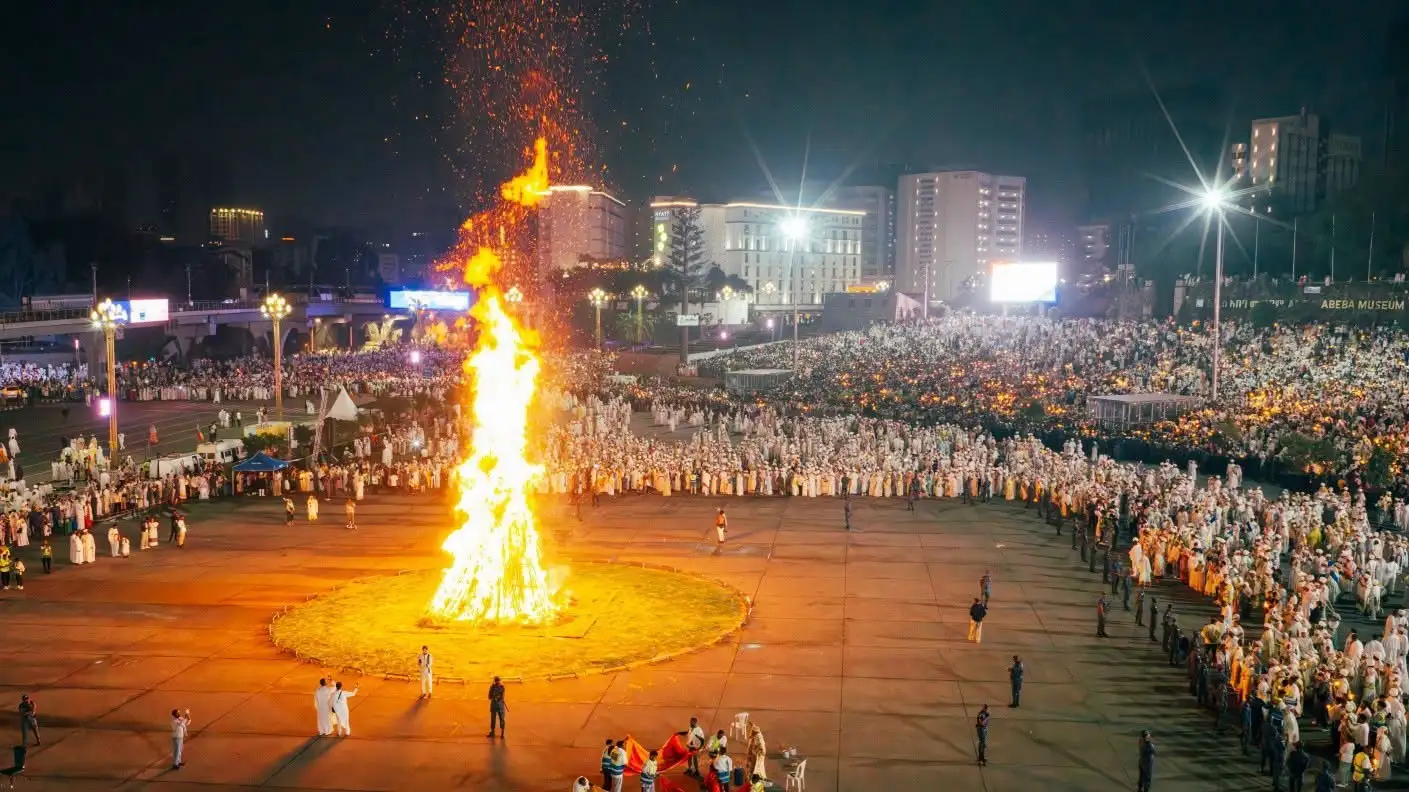
 Today, that original triumph is spectacularly mirrored across the nation. At the heart of the modern celebration remains the Demera, a towering ceremonial pyre traditionally topped with bright yellow Meskel daisies. In historic northern strongholds like Gondar, Lalibela, Debre Tabor, and Sekota, tens of thousands of worshippers draped in traditional white robes gathered around these massive wooden structures. Guided by clergy carrying ornate crosses and singing centuries-old spiritual chants, the crowds watched as the pyres burst into flames. While most of the country lit their bonfires on the eve of the festival, localized traditions in parts of the north saw the flames ignited on Meskel Day itself, reflecting the subtle, regional nuances embedded in Ethiopian Orthodox customs.
Further south, the holiday took on an even broader festive dimension, overlapping seamlessly with indigenous New Year celebrations. In these regions, solemn religious reverence merged with vibrant cultural festivities. Families reunited over traditional feasts, blending the spiritual significance of the cross with joyous celebrations of a new harvest season and the diverse heritage of the nation's many ethnic groups.
For the international visitors who traveled to witness the spectacle, the festival offered an unforgettable immersion into a living history. Mingling with locals in the crowded squares, tourists were captivated by the warmth, hospitality, and profound sense of unity that defined the atmosphere. Watching priests and everyday worshippers participate side by side gave outsiders a rare, unfiltered look into one of the world's oldest Christian traditions, inspiring many travelers to venture deeper into Ethiopia to explore its mountain monasteries, ancient ruins, and celebrated culinary landscape.

 Ultimately, the story of Queen Helena’s endurance and the glowing fire of the Demera resonate far beyond a colorful public spectacle. They echo profoundly within the long history and current reality of the nation. Just as the queen illuminated the darkness through resilience, Ethiopia has weathered historic trials and dark periods through the enduring unity and strength of her people. The shared love displayed during Meskel holds the power to burn away the darkness of poverty, hatred, and division, paving the way for the bright light of peace and prosperity.
As the towering bonfires slowly burned down to ashes, which the faithful gently pressed onto their foreheads in the shape of a cross, the lingering smoke signaled more than the close of a holiday. From remote rural villages to the bustling streets of Addis Ababa, Meskel stands as a vital bridge between generations and a dynamic intersection of culture and faith, culminating in a shared prayer and solemn pledge that the nation remains forever anchored in love, peace, and continuous growth.