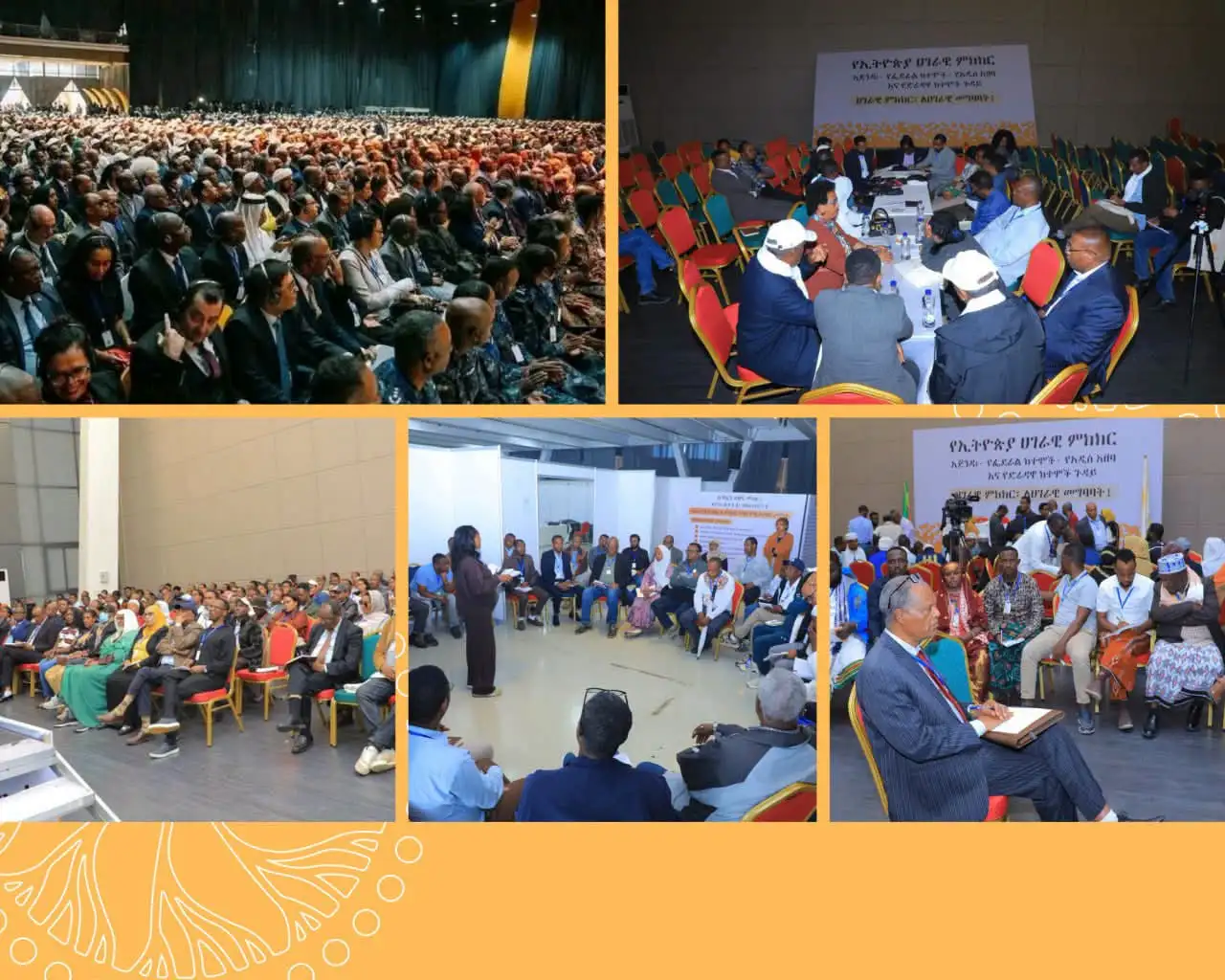
The Ethiopian National Dialogue Conference has reached major milestones in its deliberative process since its official opening on July 15, 2026. Guided by the methodology established by the Ethiopian National Dialogue Commission, the assembly continues to advance with broad public participation, transparency, and strict adherence to procedures.
The conference brings together nearly 4,000 participants representing a broad cross-section of Ethiopian society. Delegates include representatives from regional stakeholders, woreda-level constituencies, political parties, religious institutions, federal government bodies, civil society organizations, the Ethiopian diaspora, women, youth, and other organized social groups. This broad representation has created an inclusive platform that captures diverse national perspectives and experiences.
Deliberations are structured around eight nationally identified agenda items. Participants are assigned to a single thematic group of approximately 500 members for the duration of the conference, allowing for sustained, in-depth discussion and comprehensive analysis of each issue rather than rotating across topics.
To foster meaningful dialogue, discussions follow a phased methodology, starting in micro-groups of 10, advancing to sub-groups of 50, and progressing to strategic groups of 250 participants. This structured progression helps delegates exchange views, identify areas of convergence, refine differing perspectives, and establish a solid foundation for subsequent deliberations.
A panel of 80 independent experts supports the process. Before each round of discussions, the panel provides factual background, technical context, and clarifications on the agenda items to ensure informed debate while safeguarding the independence of the dialogue.
In another major milestone, delegates elected 330 representatives to join the conference's decision-making structures. These representatives were chosen from regional states, city administrations, federal institutions, woreda constituencies, women, youth, political parties, civil society organizations, teachers, eminent personalities, and government bodies.
Operational oversight is managed by 160 independent facilitators, while 158 rapporteurs systematically document the proceedings and outcomes to guarantee accurate record-keeping and procedural compliance.
Observers drawn from Ethiopian professional associations and civil society organizations are also attending the sessions, reinforcing public confidence by maintaining openness and credibility throughout the process.
Reaffirming its commitment to its founding principles and methodology, the Ethiopian National Dialogue Commission stated it will continue to provide regular updates as the conference moves into its next stages.