By: Fistum Getachew
One may ask what is the Nations, Nationalities and Peoples Day and what is the significance of observing it every year come 8th December? During imperial times Ethiopia was constituted as a unitary state where directives were given right from the heart of the capital city and implemented by officials faithful to the throne. As they were representing the emperor they were required to fulfill his orders as he saw fit to his people. The emperor may have had his Crown Council and advisors but the final say has always been his.
Power was hence concentrated in the centre and in most of the cases, in one person or in the hands of a selected few individuals. If someone from the ‘governorate generals wanted to present a grievance alleging some miscarriage of justice, they were required to wait for the day the emperor would pass in that locality and present the petition vociferously, and hope to be noted, or travel personally to the capital city and present their case before the throne, the zufan chilot the highest tribunal presided by the emperor.
Decentralization of power was inconceivable and delegation was limited to the routine activity of collection of monies or dues to the rulers by the minor officials in the regions or remote areas to the coffers of the throne.
The first Constitution in our countrys history was, granted by the emperor to the Ethiopian people in 1931 when it was recorded as generous act carried out on the emperors free will. His action was the expression of his desire to bring Ethiopia to the family of modern nations. The Constitution was largely inspired by the one promulgated in Japan by the Meiji Dynasty. But the king in Japan was largely a ceremonial chief leaving the real powers to the prime minister similar also to the British system.
Some historians did write that such constitution was considered a breakthrough as it was the first of its kind in the countrys long history. A Constitution that tried to establish in legal and unequivocal terms the powers of the monarchy was indeed unprecedented. But in the end it was not intended to limit the powers of the monarch but rather to just promote them to the attention of the citizens.
However, as it was a new concept and seemed too much forward looking for the tastes of the then feudal lords, it was taken with utmost suspicion by them that their powers would be circumvented and would lose their influence and powers in their governorates. Every now and then a sort of palace revolt or struggle seemed to transpire, but it was soon thwarted by the emperors faithful servants. The emperor was well trained how to deal with similar rebellions, or plots.
The Constitution was rather a more solid and unshakeable consecration of the powers of the monarch which virtually amounted to be placed above the law and the people. There were even provisions in the Constitution which sanctioned the ways and means of how to perpetuate the succession to the throne! This was intended to monopolize power excluding citizens from any share of it.
No doubt this document with its 55 articles and 7 chapters was just a putting on paper of the powers and prerogatives of the emperor and legitimize them. Then twenty four years later, in 1955 a so called ‘Revised Constitution’ was promulgated with more provisions with nuances.. The Revised Constitution introduced a ‘bicameral parliament’, the ‘Senate’ whose members were handpicked by the emperor, mostly prominent personalities such as former ministers and governors and the ‘Lower House’ to be filled with elected officials by the people. But even here there were certain conditions to be eligible to take part in the polls.
It was often rumoured that anyone who constituted potential danger to the authority of the emperor was ‘confined or silenced by being appointed to the Senate. In the meantime, little progress was actually made in the day to day life of the millions of masses because of this legal arrangement and the feudal system continued to reign disregarding the plight of nationals.
It was a period of African decolonization and progress was being registered in practically every field while the plight of Ethiopians continued to be unenviable with the unfettered status quo. However the fast developments taking place in many African nations began to inspire the Ethiopian students. A public uproar began to be heard with demonstrations and rallies staged by this movement. When the grievances exploded they resulted in a revolution.
The armed forces that were the backbone of the regime sided with the students and gave a final blow to the ancien regime’. Then with the stroke of a pen the military officers grabbed the reins of power deposing the aged and revered monarch, declaring the abolishment of the monarchy.
People hoped a new era was in the making that would change their livelihood extricating them from dire poverty. But the hopes and aspirations of the people were shattered by disappointments and seventeen years of this military regime commonly known as the Derg resulted in an interminable ordeal..
The promotion and imposition of socialism on the people was not palatable to the vast majority and this by itself must have contributed to the demise of the Derg. The so called Marxist Leninist stance never succeeded.
Even the founding of the Workers Party of Ethiopia did not save the regime from disintegrating. The promulgation of a socialist Constitution was considered as another attempt to legitimize the regime but in vain. Yes there was the claim by the military of doing away with the corrupt ancien regime and capitalism as was practiced in the country but in the end the rights of nationals never stood center stage. .
The new Socialist Constitution was intended to serve the interests of ‘workers and the people in general. In fact, Article 3 of the 1987 Constitution of the Peoples Democratic Republic of Ethiopia stated power belongs to the working people through its representation by the National Shengo or assembly, and the local ‘shengos’ (a kind of parliamentary assembly) to be made through elections. Article 2 talks about the country being a unitary state, but it also declares the nationalities would live based on equality. Although Article 2 sub article 4 talks about the formation of regional autonomy, the principle of democratic centralism and the hierarchy of accountability stating that lower organs are accountable to higher organs did not seem to focus on true decentralization or delegation of power. The unitary state was even more accentuated than ever before and the issue of the diversity of the peoples of Ethiopia with diverse needs and aspirations was not addressed.
This constitution as well did not exactly address the major and fundamental issues of the people and many of the provisions that particularly deal with civil liberties such as freedom of association, expression and movement or religion.
Then followed the inevitable downfall of the Derg, replaced by EPRDF the Ethiopian People Revolutionary Democratic Front, Historians say May 28, 1991 is a watershed in the history of Ethiopia.. After a couple of years, focus was given to the preparation of a new constitution replacing the old one.
After protracted discussions with public gatherings and parties participation, after debates aired on TV and radio, the 1994 Federal Constitution was drafted, deliberated and promulgated. A new ‘parliamentary’ system of government with a prime minister accountable to the House of Peoples Representatives was formed. The authorities claimed that in the process, many of the fundamental issues of the Ethiopian society were seriously portrayed and discussed.
The Federal Constitution of Ethiopia of 1994 has been acclaimed by many intellectuals as among the best in the world. Such Constitution is acknowledged as an outstanding document that enshrines the most advanced ideas in the political, social and economic spheres even by the fiercest critics and opposition elements that did not see eye to eye with the incumbent.
In Chapter Four Articles 45 and following, the State Structure is amply described. The Prime Minister has the executive power, while the Presidents position is largely ceremonial and super partes. Then there is an independent Judiciary and the Legislative body. The bicameral parliamentary system consisting of the House of People's Representatives and the House of Federation is key and has its own raison dètre. Electoral districts elect the 547 representatives for the House every five years, and the party that earns the majority of the votes nominates the Prime Minister.
To date Ethiopia has carried out six elections with the National Electoral Board managing it and the seventh election is due this Ethiopian year, 2018.. A good preview of the Constitution can be experienced beginning from the very preamble which states:
We, the Nations, Nationalities and Peoples of Ethiopia strongly committed, in full and free exercise of our right to self-determination, to building a political community founded on the rule of law and capable of ensuring a lasting peace, guaranteeing a democratic order, and advancing our economic and social development; firmly convinced that the fulfillment of this objective requires full respect of individual and peoples fundamental freedoms and rights, to live together on the basis of equality and without any sexual, religious or cultural discrimination have adopted, on 8 December 1994 this Constitution through representatives we have duly elected for this purpose as an instrument that binds us in a mutual commitment to fulfill the objectives and the principles set forth above.
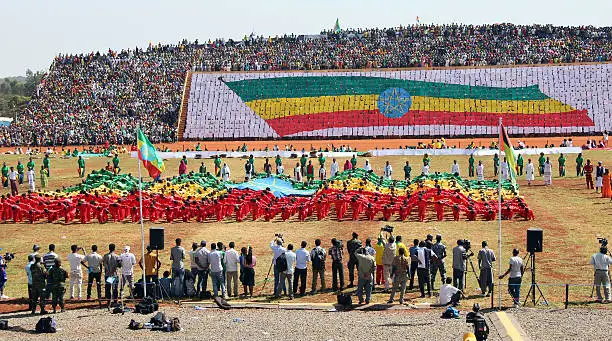
And the celebration of the Nationals, Nationalities and Peoples Day is based on this Federal Constitution that recognizes the rights of every nationality in the country. In fact in application of this principle three more new regional states have been formed recently following the requests of the people living there. The reformist government that has acceded to power some years ago has accepted the demands of the public and put in practice the words of the 1994 document.
Pertaining to the outstanding issues that need to be sorted out and in search of a consensus, this government has established what is called the National Dialogue Commission which has been working now for more than three years and is now reaching vital point. It has identified most of the issues raised by the population here and the Diaspora and it has made many preliminary discussions with large sections of the population.
As we observe the 19th ‘Nations, Nationalities and Peoples Day’ we need to acknowledge these developments and hope that fruitful results will be borne out of these discussions so that the country reaches a certain consensus on the way forward and strengthened the bond between all nations and nationalities.
Undoubtedly, Ethiopia needs a clear pact for its future development trajectory and not be influenced or still worse determined by past narratives which are often outmoded and futile boring when they are repeated again and again across the years just to fulfill certain political forces that hope to come to power. Instead, Ethiopians need to focus on matters that relate with most of them than be prey to divisive ideas and narratives that would only contribute to divisions which is the hope of our historical enemies and prevent us from becoming a relevant and influential country not only in Africa but also in the Global South and beyond.