By: Fistum Getachew
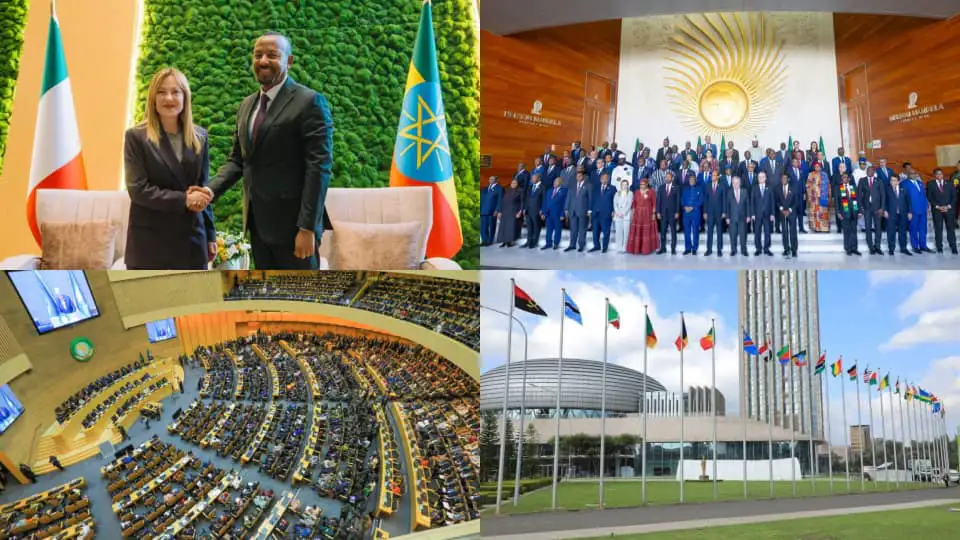
The 39th AU Summit was held in Addis and ended successfully both for Africa as a whole and also specifically for the host, Ethiopia. It was a few days of significance and brilliance for Ethiopia’s capital city, which is also called the capital city of the continent. Addis Ababa and the African Union have a long history of a very close relationship that could be equated to a marital relationship. It is impossible to think of the AU without referring to Ethiopia, so closely interrelated they are.
The Summit was held on the days of February 14th and 15th, and it was a significant summit following another important conference, namely the 2nd Italy-Africa Summit, held on African soil for the first time. The prime minister of Italy, Georgia Meloni, addressed the summit, in which she stressed the need of cooperation between Italy and Africa as well as Europe and Africa. She said cooperation could be conceived and realized only if it is done on an equal basis and not with the concept of hierarchies. Meloni noted that Italy and Europe cannot think about the future without taking Africa into proper consideration, “because our future also depends on yours.”
Referring to the Italy–Africa partnership and the Mattei Plan, Meloni said it is a strategy built together. “This is a strategy that we have built together, because we do not conceive of the Mattei plan as an Italian plan for Africa but as Italy's contribution to your agenda, with a particular focus this year on water-related projects.” Meloni said, “We will continue to do our part, because we are aware that the future of Italy and Europe also depends on a secure, prosperous, and peaceful Africa.”
The assembly has repeatedly discussed on issues of peace and security considered as a matter of urgency. The theme of the Summit was “Assuring Sustainable Water Availability and Safe Sanitation Systems to Achieve the Goals of Agenda 2063. It was a summit where African heads of state reaffirmed their commitment to long-term development and regional integration. They all dealt with the subject in their speeches to the audience.
For Ethiopia it was another point of pride as the entire event concluded with success without any inconveniences or hiccups to the delegations and their respective participation in the summit. They have ended the deliberations according to schedule, and in this respect, the Addis Ababa City Administration and the city's police have thanked the residents for the warm reception they accorded to the guests by leaving the relevant roads to facilitate smooth traffic flow to and from the airport, the conference venue, and the hotels.
Ethiopia has once again received the appreciation and gratitude of those who came to Addis Ababa for the 39th AU Summit. All those who were approached by our media expressed their admiration for the warm welcome they were accorded by Ethiopian authorities as well as the hospitality staff wherever they stayed and passed the two, three days of their sojourn in Addis. They also expressed their feeling of surprise about the new face of Addis, full of beauty and cleanliness, a deserving venue and seat for the AU. In fact, they said that Addis is, after all, the capital of Africa, and we feel at home here. The transformation that it has undergone during the past few years has surprised them, they stated. One delegate said he was in Ethiopia two years ago, and when he came this time around, he could not recognize it and felt he was totally lost. Another guest said she did not believe that she was in Addis but some other place, such as Dubai!
One delegate said that he was impressed by the newly made parks and recreation spaces as well as the green areas in the city, adding that other African countries as well should emulate Addis and make their cities just as Addis did. He appreciated the leadership of Prime Minister Abiy Ahmed (PhD), who is in the forefront of the progress the city has achieved.
Ethiopia's role in the Pan-African movement is a well-known fact, and Ethiopia has not only inspired African nations to struggle for their liberation from the colonial yoke but also contributed its part in advancing the Pan-African movement and pushed for the unity of all peoples of African descent.
The AU and Ethiopia have a special relationship because it is here in Ethiopia that the AU was conceived and born. It was Emperor Haile Selassie as well as his foreign minister Ketema Yifru who tirelessly labored for months to iron out the discrepancies that had emerged among the African leaders and, along with other ‘founding fathers,' realized the dream of the establishment of the Organization of African Unity in Addis. The likes of Kwame Nkrumah of Ghana, Ahmed Ben Bella of Algeria, Gamal Abdul Nasser of Egypt, Julius Nyerere of Tanzania, and Jomo Kenyatta of Kenya were, among others, the principal protagonists of the formation of the OAU in Addis. The two regional factions that were called the Monrovia Group and the Casablanca Group were made to merge and become one under the new name of the OAU. Here again the efforts of the emperor and his aids cannot be overstated.
The prestige and reputation of the emperor here were decisive along with ‘the founding fathers’. The emperor had obtained the attention and admiration of the world due to his struggle against the aggression of colonizers by going to the League of Nations and appealing for the international body to take actions against the fascist invasion of Ethiopia. The speech he delivered at the League of Nations is still considered as one of the most influential ever given there, as it had warned that the law of might was a dangerous stance to submit to and could in the future have severe consequences in the international sphere. That speech is considered historic for the repercussions it has brought about in the psyche of nations, particularly the smaller countries that were risking being overwhelmed by the might of the bigger ones. His speech was considered a prophecy when later on there were the invasions of European countries by the Nazi forces in company with the Fascists. The speech was considered a groundbreaking assertion of the right to be free and that people of African descent should rise up against any form of oppression. He urged them to stand up for their rights. After that, Haile Selassie was regarded as the symbol of resistance against aggression and injustice.
Hence, his efforts in trying to found the OAU were blessed and crowned with success, and he was given all the credit he deserved. This is, in a way, the origin of the history of the OAU, now the AU, and it is this special relation that Africans do recognize and give credit to Ethiopia for.
Ethiopia’s diplomatic success in this respect cannot be overstated because it has, in a way, become part of the identity of Ethiopia. Besides being one of the historic founders of the OAU, it has also been one of the founders of other international organizations, such as the UN, IGAD, and others. And all the missions in which Ethiopia has taken part have added to its reputation in the diplomatic sphere. The successful completion of the 39th AU summit is hence another gem to be added to the already shining history of Ethiopia and its diplomatic status in Africa in particular and the world in general.