
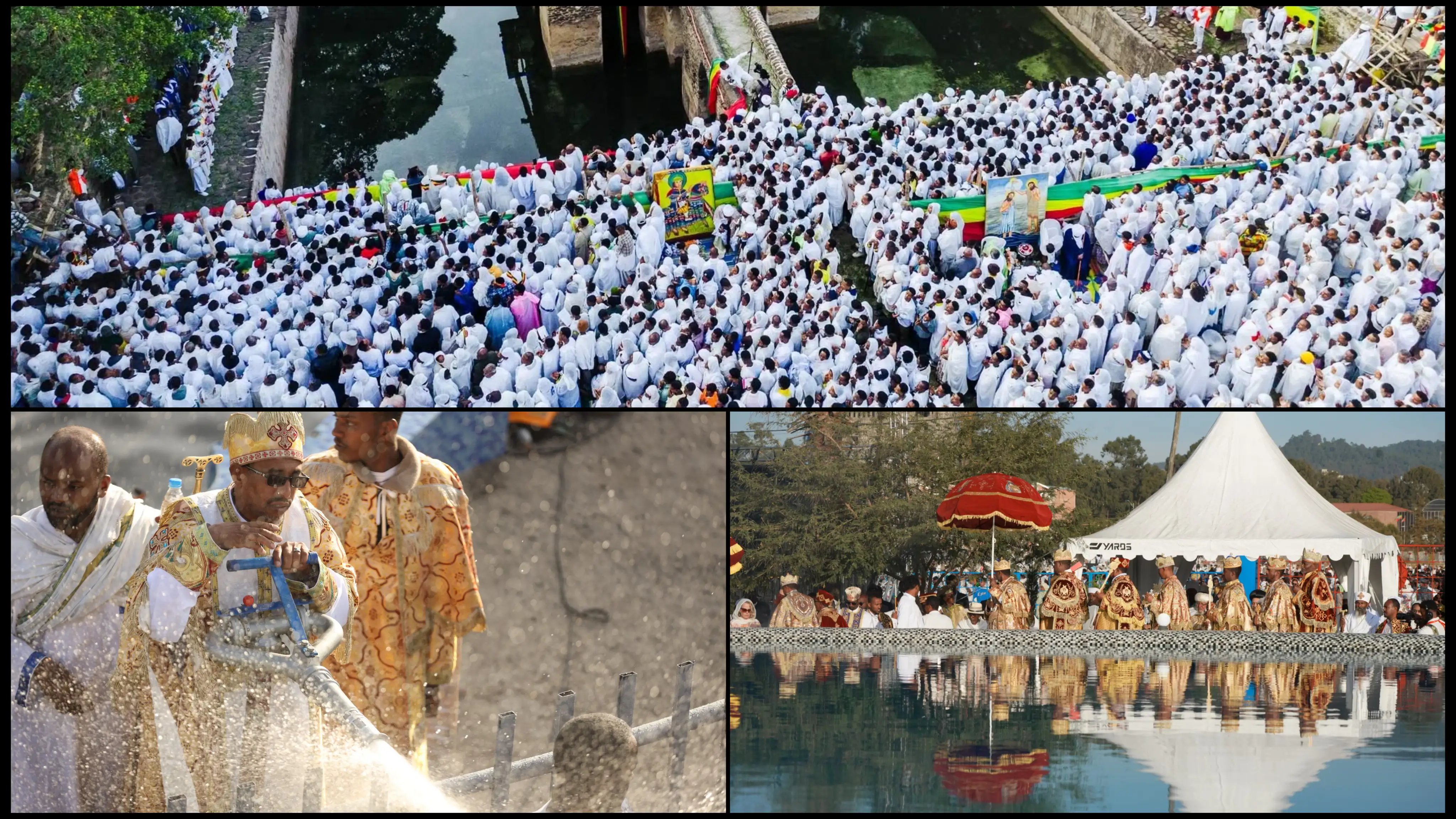
The Feast of Epiphany (Timket) is one of the primary outdoor festivals celebrated by the Ethiopian Orthodox Tewahedo Church. Because it possesses both religious and historical foundations, it is a celebration steeped in deep mysteries.
Church records indicate that Timket has been celebrated in its current form since the 4th century. Since the era of Kings Abreha and Atsbeha, great care has been taken to ensure the religious rites of this festival remain preserved and intact.
As the Tabots (replicas of the Ark of the Covenant) leave their hallowed altars to spend the night near a body of water, they are escorted by massive processions filled with hymns and praises. Depending on local culture and language, various communities add their own unique expressions, making the festival a vibrant blend of religious, historical, and cultural events.
The core teaching of Timket begins with the redemptive work of Jesus Christ in the flesh. At the age of thirty, He traveled from Nazareth in Galilee to the River Jordan. This was a journey of humility—a great mystery where the Creator submitted to the creature, and the Master came to His servant.
According to Church doctrine, when St. John the Baptist tried to prevent Him, saying, "I need to be baptized by You,"the Lord demonstrated through word and deed that it was necessary to fulfill all righteousness. The Prince of Life, who was raised in Galilee, descended into the Jordan to set humanity free from the bondage of Adam and to serve as an example for rebirth through water and the Spirit.
The Church teaches that the Mystery of Baptism revealed at the Jordan was a "Festival of Great Light" where the Unity and Trinity of the Holy Trinity were clearly manifested. As the Lord was baptized by the hand of John, the Father witnessed from the clouds, saying, "This is my beloved Son, in whom I am well pleased,"and the Holy Spirit descended upon Him in the form of a dove.
This is what makes Timket a "Feast of Revelation"(Epiphany). This revelation is the first of all Church mysteries. Teachers of the Church explain that it is called a "mystery"because through a service that is seen by the eye and heard by the ear, an invisible grace is obtained that cannot be perceived by physical senses.
While the physical act of the service is visible and audible, the grace of adoption—whereby the baptized is reborn of water and the Spirit—is spiritual and unseen. This mystery serves as the gateway to all other Church sacraments and the Kingdom of Heaven.
"At this moment, humanity's lost sonship was restored; the soul defiled by sin received the grace of purification through the baptism of Christ. In Church history, the Jordan ceased to be a symbol of death and judgment and became a source of life and salvation for all believers."
Combining religious, historical, and cultural elements, Timket is one of Ethiopia's most unique and primary festivals. It possesses a magnetic power that draws the world to Ethiopia to witness it. Recognizing this, UNESCO inscribed the festival as a World Intangible Cultural Heritage on December 11, 2019 (Tahsas 01, 2012 E.C.).
While this recognition is a significant step, there is still much work to be done in promoting Timket globally and establishing it as a central hub for international tourism. As a festival that intertwines Ethiopia's diverse identity with its ancient religious roots, it remains a powerful platform for showcasing the country to the world.