
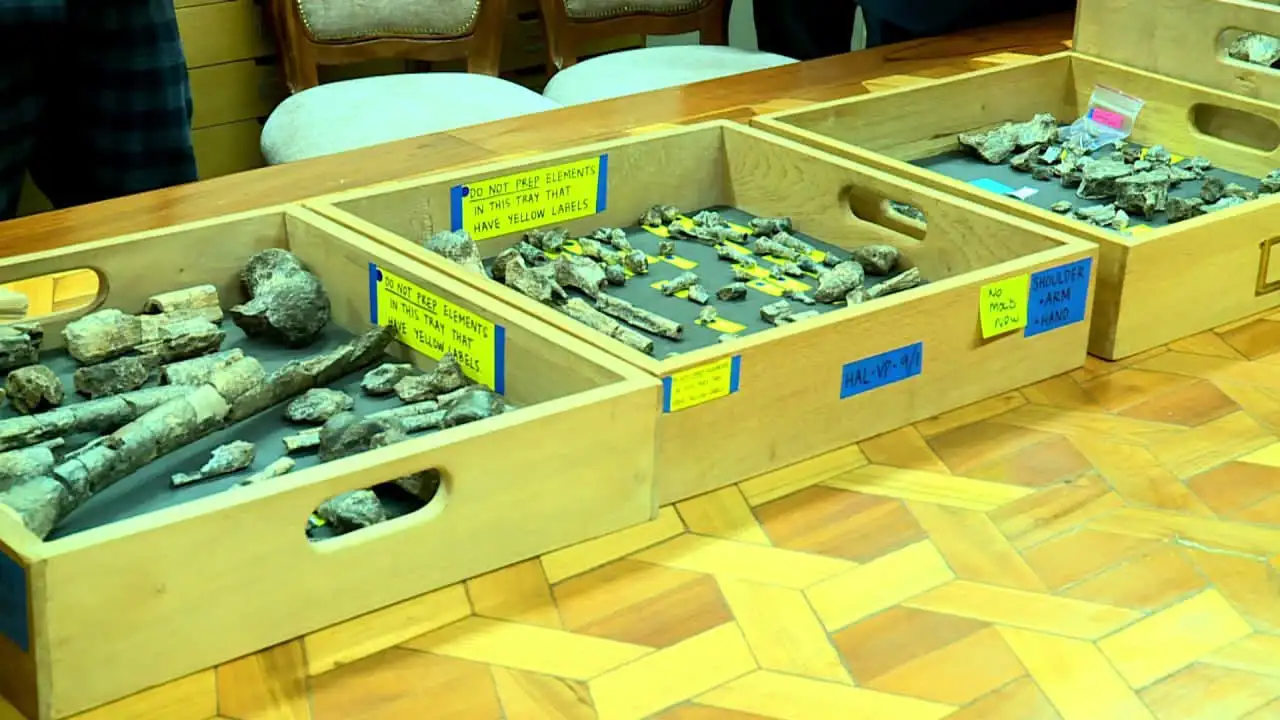
The Ethiopian Heritage Authority has announced a groundbreaking archaeological discovery in the Middle Awash project of the Afar Rift Valley, uncovering fossils and stone tools of ancient *Homo sapiens* dating back over 100,000 years.
The findings, published today in the prestigious international scientific journal Proceedings of the National Academy of Sciences (PNAS), represent the culmination of years of multi-national research led by Dr. Yonas Beyene and involving scientists from 24 countries.
This discovery is of immense scientific value as it helps bridge a significant historical data gap between 900,000 and 200,000 years ago in the timeline of human evolution. The research provides a detailed look at the origins of Homo sapiens, their technological advancements through stone tools, and the environmental conditions of the era.
Key Scientific Insights:
Technological Sophistication: Thousands of meticulously crafted stone tools were found at a site called Halibi, showcasing early human ingenuity.
Environmental Shift: Fossil remains of monkeys, rodents, birds, and horned animals suggest that 100,000 years ago, the now-arid Afar region was a lush, forested environment supported by the ancient Awash River.
Global Impact: Assistant Professor Abebaw Ayalew, Director General of the Ethiopian Heritage Authority, noted that the government's focus on scientific research is consistently yielding discoveries that serve as a gift to global history and the tourism sector.
Researchers Dr. Yonas Beyene and Dr. Berhane emphasized that these findings provide the most complete information to date regarding the lives and movements of early modern humans in the region, firmly re-establishing Ethiopia's status as the origin of the human race, ENA reported.