By: Fistum Getachew
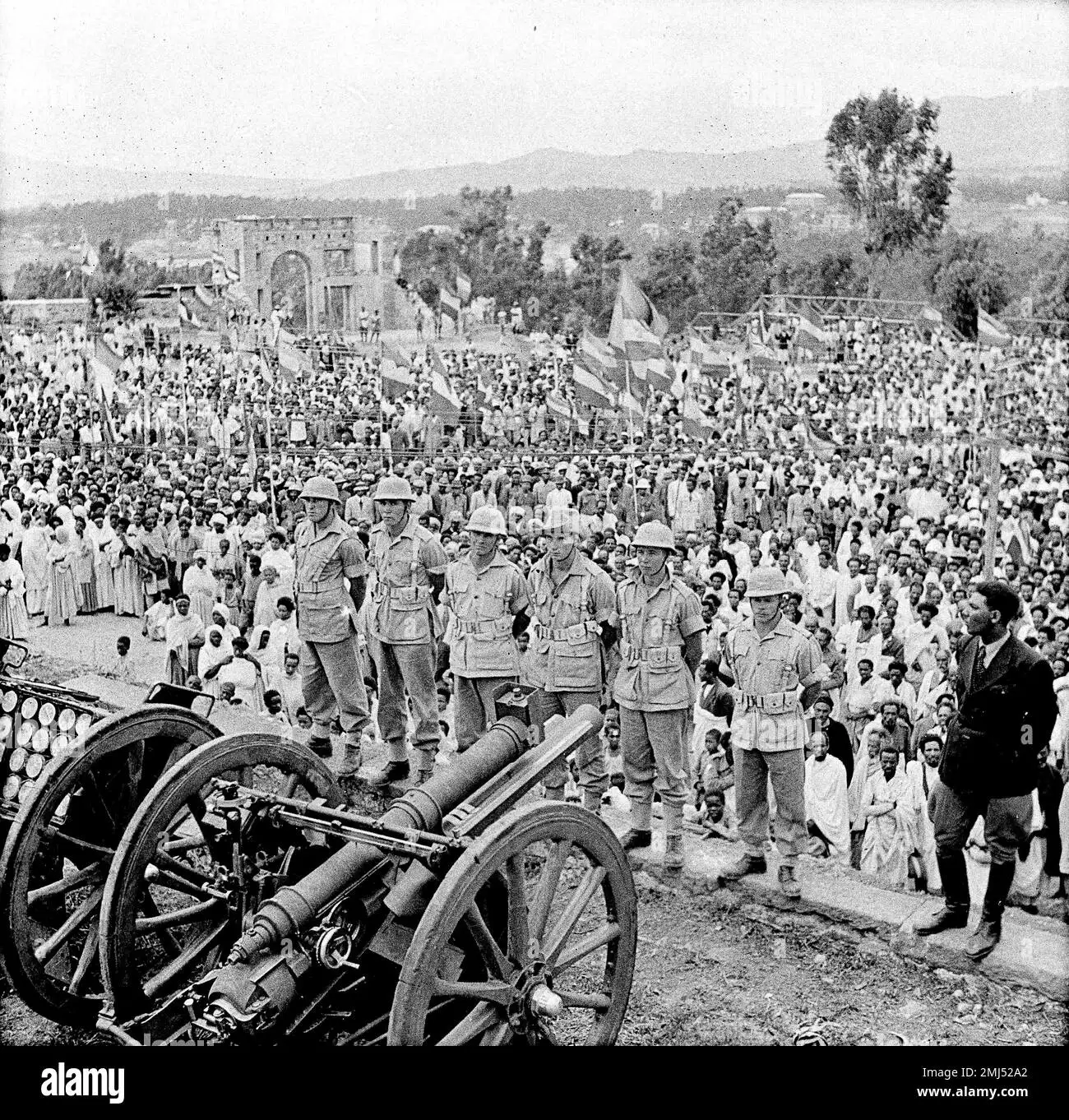
May 5, 1941 stands as one of the most defining moments in modern Ethiopian history—a day that symbolized not only a military and diplomatic victory against a formidable foe but also the resilience, unity, and unyielding spirit of a nation that refused to surrender its sovereignty as well as territorial integrity. On this day, the former Ethiopian Emperor Haile Selassie escorted by patriots triumphantly re-entered Addis Ababa, marking the official end of five years of brutal Italian fascist occupation of the country as well as the immeasurable suffering of Ethiopians.
The liberation was not a simple military event achieved with out protracted struggle of Ethiopian patriots, immense resilience and perseverance. But it was rather the culmination of sustained resistance by Ethiopian patriots, supported by the larger public as well who furnished them with vital information regarding the enemy forces and helping them with the provision of food and other necessities during the battles they had to fight. Ethiopia also had the support of international alliances, along with the enduring resolve of a people who would never accept being subdued by any external force. It is known that Ethiopians have a long tradition of independence and persistent rejection of subjugation by any invader. Their commitment to their freedom is immense and is engraved in their psyche as part of their DNA.
The roots of this historic day lie in the Fascist Italy invasion of Ethiopia in October 1935, led by Benito Mussolini’s regime. Italy sought to expand its colonial empire and avenge its humiliating defeat at the Battle of Adwa in 1896, where Ethiopia had successfully defended its independence. This time, however, Italy deployed modern weaponry, including tanks, aircraft, and even chemical weapons such as mustard gas, in blatant violation of international law. Despite Ethiopia’s membership in the League of Nations and its appeals for support, the international community largely failed to intervene effectively, exposing the weaknesses of collective security at the time.
Faced with overwhelming military superiority, Ethiopian forces initially struggled to repel the invaders. By May 1936, Italian troops had occupied Addis Ababa, and Emperor Haile Selassie was forced into exile to launch a diplomatic battle while the Ethiopian patriots continued to fight in multiple fronts across the country rejecting the dominion. Yet, while the occupation appeared complete on the surface, it was never fully consolidated. The invaders never felt at home or secure because they were continuously attacked using guerrilla tactics. Across the countryside, Ethiopian patriots commonly called Arbegnoch continued to resist Italian control. These patriots were active in the countryside well organized and sleepless by engaging in all sorts of warfare including sabotages and constant harassment of enemy forces.
The five-year resistance that followed was one of the most remarkable aspects of Ethiopia’s liberation. Unlike conventional warfare, this resistance relied heavily on local knowledge of the Ethiopian landscape and terrain, mobility, and wide popular support. Leaders such as Ras Abebe Aregai, Dejach Belay Zeleke, and others including countless unnamed fighters organized and sustained campaigns that kept the spirit of resistance alive. These patriots operated under extremely difficult conditions, lacking sufficient weapons, supplies, and formal training. Nevertheless, their determination prevented the Italians from ever achieving complete control over the country and sleep comfortably.
Italian occupation was marked by harsh repression and widespread atrocities. The fascist regime implemented policies designed to crush resistance and impose colonial rule, including mass executions, imprisonment, and the destruction of villages suspected of supporting patriots. One of the most infamous incidents was the ‘Yekatit 12’ massacre (February 19, 1937), where thousands of civilians were killed in retaliation for an attempted assassination of the Italian viceroy, Rodolfo Graziani. Such acts only deepened Ethiopian resolve to resist foreign domination instead of blowing up the moral of Ethiopians and force them to accept submission to the enemy.
While internal resistance played a crucial role, Ethiopia’s liberation was also influenced by global developments, particularly the outbreak of World War II. Italy’s alliance with Nazi Germany placed it in direct conflict with the Allied powers, including Britain, France and the USA. Recognizing the strategic importance of the Horn of Africa, British forces launched a campaign against Italian East Africa in 1940–1941. Ethiopian patriots coordinated with British troops, creating a powerful alliance that combined local resistance with organized military operations.
Emperor Haile Selassie, who had been in exile in the United Kingdom, seized this opportunity to return and lead the liberation effort. In early 1941, he re-entered Ethiopia through Sudan, accompanied by a small force and supported by British military units and Ethiopian patriots. As he advanced into the country, he was joined by thousands of patriots who had been fighting for years in the mountains and rural areas. This convergence of internal resistance and external support proved decisive to totally overcome the fascist forces.
The campaign to liberate Ethiopia progressed rapidly. Key towns and strategic positions fell to the advancing forces, and Italian troops, weakened by years of resistance and the broader pressures of World War II, began to retreat. Finally, on May 5, 1941, Emperor Haile Selassie entered Addis Ababa, greeted by jubilant crowds celebrating the end of occupation. His return symbolized the restoration of Ethiopian sovereignty and the triumph of national unity over foreign domination.
The significance of May 5 extends beyond the immediate military victory. It represents a powerful example of resistance against colonialism and fascism at a time when much of Africa was under European rule. Ethiopia’s ability to reclaim its independence challenged the notion of European invincibility and inspired anti-colonial movements across the continent. For many Africans and people of African descent worldwide, Ethiopia became a symbol of pride, resilience, and hope.
Moreover, the Ethiopian resistance demonstrated the importance of unity in the face of external threats. Despite internal divisions and regional differences, Ethiopians from various backgrounds came together to defend their country. This collective effort was essential in sustaining the long struggle against occupation. It also highlighted the role of ordinary citizens, not just political leaders or soldiers, in shaping the course of history.
The liberation also had significant political implications. After returning to power, Emperor Haile Selassie returned to modernize the country and strengthen its institutions as it had begun before the aggression and occupation of the country. Although these reforms had mixed outcomes, they reflected recognition of the need to adapt to a changing world and prevent future exposures to eventual assaults by any external force. The experience of occupation underscored the importance of national unity, strong governance, and international engagement in diplomatic activities.
At the same time, it is important to view this period with a critical perspective. While the victory of May 5 is rightly celebrated, the years that followed were not without incidents of challenges. Ethiopia faced economic challenges in a fast changing world. There were also political and social issues in subsequent years. But things were also destined to change across the years. Ethiopia was slowly joining the changing world, adapting to it. The historic isolation of Ethiopia of the past was all gone and forgotten. Nevertheless, the memory of the resistance and liberation remained a unifying narrative that continued to shape national identity.
From a broader historical perspective, it could be asserted that Ethiopia’s liberation in 1941 was part of the larger struggle against fascism during World War II. Although often overlooked in global narratives, the East African campaign played a vital role in weakening Axis powers and securing Allied interests in the region. Ethiopian patriots did take part and were not merely passive beneficiaries of Allied victory; they were active participants who contributed significantly to the defeat of Italian forces.
The legacy of May 5 also lives on in cultural and national consciousness. It is commemorated as Patriots’ Victory Day (Ye Arbegnoch Qen), honoring those who fought and sacrificed their lives for the country’s freedom. The stories of these patriots—both well-known and anonymous—serve as reminders of the courage and determination required to defend the sovereignty and territorial integrity of the country. They also provide valuable lessons for future generations about the importance of resilience, unity, and patriotism. Ethiopians of all walks of life today are proud of their forefathers who handed them a free country unlike what had happened in other African countries where the yoke of colonial domination lived up to the 1960s and beyond. In the meantime lots of sacrifices were paid before attaining full liberation. Ethiopia is often mentioned as one of the inspirations of Africans in their drive to fight colonialism.
In contemporary Ethiopia, the memory of the 1941 liberation continues to hold relevance. It serves as a reference point in discussions about national identity, independence, and the challenges of maintaining unity in a diverse society. The spirit of resistance that defined the five-year struggle remains an enduring symbol of the nation’s strength and determination. That is why it is observed every May 5. It is the ideal day when all those who fell during the five year fascist occupation are remembered and honoured.
Furthermore, the Ethiopian experience offers insights into the dynamics of resistance movements more broadly. It illustrates how local knowledge, popular support, and determination can offset material disadvantages in the face of a more powerful adversary. It also highlights the importance of international alliances, even as it underscores the limitations of global institutions like the League of Nations during times of crisis.
Ultimately, May 5, 1941, is not merely a date in history; it is a testament to the enduring power of a people who refused to be conquered. It encapsulates a narrative of struggle, sacrifice, and victory that continues to inspire. The five-year resistance against Italian occupation stands as one of the most remarkable chapters in Ethiopia’s long history—a story of how determination and unity can overcome even the most formidable challenges.
As Ethiopia reflects on this historic day, it is important to honor not only the victory itself but also the values that made it possible. The courage of the patriots, the leadership of those who guided the struggle, and the resilience of ordinary citizens all contributed to a triumph that resonates far beyond national borders. In remembering May 5, Ethiopians celebrate not just the end of occupation, but the enduring spirit of freedom that defines their nation.
Ethiopians’ struggles to foil any form of aggression or any attempts by alien forces to conquer their country have always succeeded. Indeed, it has become the identity of a nation that has always resisted invasions and occupations of any kind for centuries. However, this state of affairs was presumably never tolerated by European powers; that a country such as Ethiopia which is found in a geopolitically strategic area could enjoy full sovereignty and not be subject to the ‘influence’ of one of the then powers of Europe.
While we celebrate the heroic deeds of our forefathers, our courageous patriots, we do not forget or dismiss the kinds of risks that the Ethiopia of today still runs due to its geopolitical location and the natural resources it avails. That is why securing free access to sea is a major agenda of the current government. It has repeatedly stated that it would not stop from leaving any stone unturned to achieve such sea access in a peaceful and diplomatic manner. Such quest of Ethiopia is also supported by many international actors given the size of the country, its vicinity to the sea and the way it has been deprived of its historical right to have free access to the sea. Ethiopia’s growth and prosperity can only be guaranteed with access to sea to strengthen its participation in world and more particularly in regional affairs.