
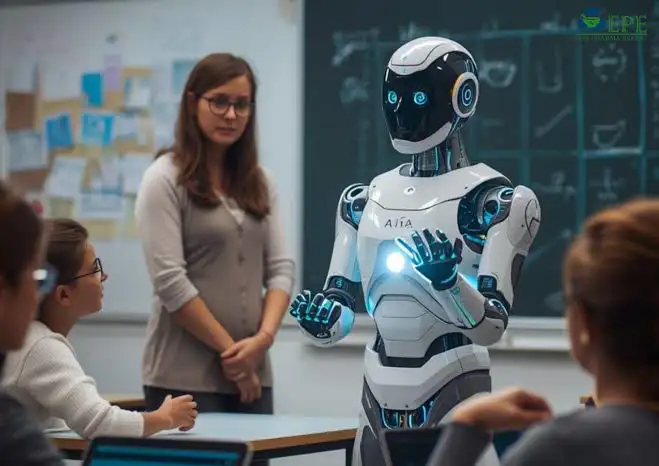
The Ministry of Education has officially developed and deployed a pilot version of an "Agentic AI Teacher Assistant," a groundbreaking application designed to autonomously handle instructional tasks and significantly reduce the administrative burden on secondary school teachers.
Dr. Zelalem Assefa, Lead Executive for ICT and Digital Education, emphasized that the software represents a significant technological achievement as it operates entirely offline. Unlike many modern AI tools, it does not rely on cloud technology or centralized servers, but instead runs locally on standard laptops or desktop computers without requiring high-end hardware.
The application has been specifically fine-tuned using a comprehensive dataset consisting of all textbooks for grades 9 through 12, ensuring it is fully aligned with the new national curriculum. This allows the AI to autonomously generate lesson plans, develop standardized exam questions and assignments, and formulate effective pedagogical strategies.
By automating these routine bureaucratic processes, the tool is intended to grant teachers more time for direct student interaction while simultaneously serving as a capacity-building resource that improves teaching quality. The pilot phase in selected schools has already yielded satisfactory results, and the Ministry has begun training teachers and IT professionals from all regions to implement the technology.
Dr. Muluneh Atnafu, an advisor in the ICT department, noted that the AI assistant is a vital component of the Ministry’s broader digitalization strategy. Because the software functions in a fully offline mode, it plays a critical role in bridging the digital divide, ensuring that schools in rural or remote areas with limited internet access can benefit from the technology without interruption.
Furthermore, the application is highly cost-effective; once installed, it eliminates the need for monthly internet fees, network infrastructure expansion, or recurring subscription costs. By facilitating better support for continuous student assessment, the Ministry expects this tool to play a major role in improving academic outcomes across the country.
The initiative is supported by the World Bank-funded Ethiopia Education Transformation Operation for Learning (ETOL) project, which is providing the technical assistance and infrastructure necessary for both the pilot implementation and future national scale-up.