By: Fistum Getachew
In the coming weeks Ethiopians will sit down to consult and deliberate on fundamental national issues that have been the source our differences and our incapacity to converge on them as one. For several generations, it has been impossible to reach a consensus and agreement on these issues once and for all.
There are people who say that Ethiopian modern history has been reported to span a hundred years since the advent of Emperor Menelik to the throne. Then followed Empress Zewditu and Emperor Haile Selassie after which the military regime of the 1970s took charge. It was after the overthrow of the military that the current format of the country with a federal constitution was established.
Historical records show that it was during the monarchy that the student movement began at the university level in the early sixties with continuous rallies and public outburst that eventually led to the downfall of the last monarch. The then initiators of the movement were largely graduates of foreign universities who were sent for higher studies in the various European countries and mainly the USA. They had read about the various revolutions such as the French Revolution, the American Revolution and the Russian Revolution.
These historical records inspired them to press ahead for change in their native land once they returned and that was what they immediately began to act upon. They expressed their discontent and opposition to the monarchical, feudal, and aristocratic system in which a few controlled the entire resources of the country. They began staging rallies and writing pamphlets with fiery political content taking advantage of the relative freedom of expression at least in the university campuses. Emotions began to skyrocket instigating the entire university and student community to support the movement.
It was in those years that most of the leaders of the country of the seventies and eighties were formed calling for the right of all peoples in Ethiopia to self-determination and that beginning became the background to the drafting of the current constitution which is still in vigour. However, this did not mean that everything the student movement proposed was accepted and applied across the board.
There were various divisions and factions that wanted to say what they called ‘their truth’ about how the country was founded to begin with. These people argued that Ethiopia the country itself was not founded on a just basis because they said it discriminated or favoured some nations as compared to others. Since the creation of the entity Ethiopia there have been committed injustices on certain communities they say who were incorporated to Ethiopia run by the kings and their circles in the north and the history and existence of the other peoples were not taken into due consideration.
As the way the modern country was founded, they did not feel they were duly represented and that has led them to seek autonomy or even independence from the country because they said they felt discriminated and had a feeling of not belonging to it! Such sentiment has always constituted a fundamental disagreement between forces who sustained the country and those who opposed it in certain domains.
The student movement was inspired mainly by the so-called Leninist or socialist approach of ‘the rights of people to self-determination’ and this has become a fundamental and controversial issue through the last several decades distracting and even obstructing the country’s development ventures.
For decades since the sixties there have been so-called liberation movements formed on ethnic basis trying to make their voices heard at the central government level. Such claims of course presented a danger to the integrity of the nation and given the presence of rivals or enemies of Ethiopia on foreign ground, there arose the need to safeguard the integrity and sovereignty of the country from the destabilizing forces which helped these opposition movements flourish and be a thorn in the nation’s body.
Across the years, Ethiopians have been engaged in interminable intestinal conflicts due to these elements. What is unfortunate is that there were no means of reconciliation with them deriving from civilized and sober discussions. The perennial disagreement between the central government and the so called opposition forces persisted without a solution acceptable to both parties.
This issue has been the agenda of Ethiopians and considered a thorny issue with no solution in the horizon. One of the key questions that were always raised has been the search for an Ethiopia that can be called ‘equally home’ for all of the communities in it without any form of distinction. But to reach at a similar consensus there were calls for an all-encompassing consultation between the various nations and nationalities of the country. But such a venue was not to be available until the foundation of the National Dialogue Commission which was formed some four years ago.
After four long and toilsome years of activities of the Commission which were conducted throughout the country and abroad where there are the diaspora, gathering and selecting the major and crucial national points of discussion, it has now reached the final stage of actually proceeding to the conference in which the agendas will be discussed through the exchange of frank views and candid consultations in a faithful and constructive manner.
During the agenda collection process every community, every vested interest group of national significance and relevance has been included. In fact even those groups which have chosen to resort to arms to try and form their own government deposing the incumbent were invited to take part in the selection of the agendas peacefully. Some have heeded the call and contributed to this initiative with enthusiasm because they have come to realize that only through peaceful discussions and negotiations could we reach a certain consensus and exist as one country under a unique Federal Constitution leaving enough space for the various regional states.
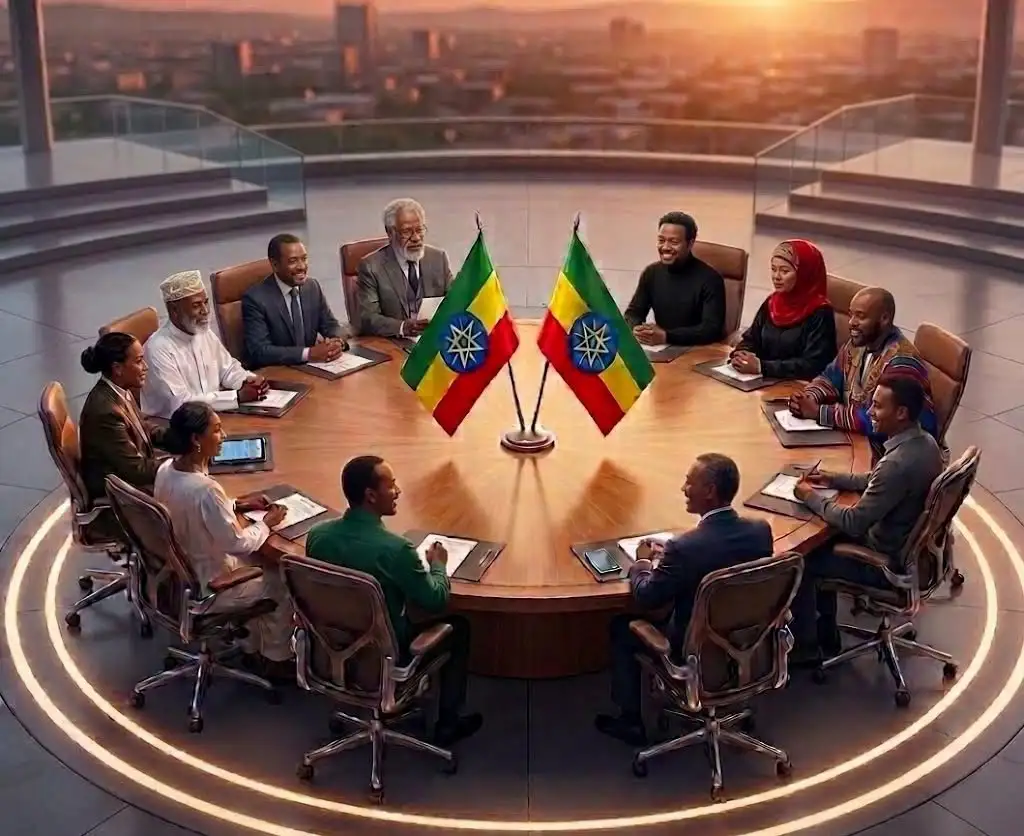
These discussions will be held between four thousand delegates who are all now present in Addis Ababa ready to contribute their part in the search for a national consensus based on fundamental and universal principles such as the supremacy of the law particularly the Constitution, the rule of law equal to all citizens, various forms of freedoms such as freedom of expression, freedom of religion, freedom of association etc. which in fact are part of any democratic constitution.
As a matter of fact, even the 1994 Ethiopian Federal Constitution enshrines these ideals even though there are some who argue that there should be certain reviews to be made because fundamentally the constitution is deemed to have been imposed from above on the people down without the necessary discussions among the population at large.
And since then the issue has become a source of fierce controversies. That is why one of the reasons for this initiative called the National Dialogue Commission was taken by the incumbent.
Talking about this Commission a few days ago Prime Minister Abiy Ahmed (PhD) was heard underlining the crucial importance of the forthcoming discussions and debates as they can open a new chapter in the history and destiny of the country. He dismissed all those arguments that come from certain forces trying to belittle the works of the Commission.
The premier said the search for consensus among Ethiopians has been a constant demand of various forces and there were sacrifices paid in order to reach such a stage we are now in. Hence, he noted, we should consider it with due seriousness and contribute our part for its success.
The National Dialogue Commission has gone through very difficult times when it went into every woreda and region of the country in search of people ready to present the agenda that the conference should consider. At times, it had to face certain hostile conditions accusing the members of siding with the incumbent and hence not susceptible of credibility. They had to convince similar forces that their cause was not the cause of the government but of the people of Ethiopia and hence every one could state whatever agenda they have of national interest without focusing on strictly local issues. This is because the mandate of this conference is to deal with issues of national relevance and reach a certain common destination.
At the same time these discussions have led Ethiopians to learn to discuss issues openly and peacefully adopting hence a democratic way of discussing and making it a durable habit.
It has been reported that eight principal agendas have been selected for discussion and they will be debated in the conference among the delegates. It is expected that the conference will last about four weeks and all the necessary arrangements have been prepared.
According to the Chief Commissioner of the National Dialogue Commission Professor Mesfin Araya, the upcoming National Dialogue Conference will serve as a platform to resolve the issues underlying Ethiopia's longstanding differences through peaceful consultation.
Professor Mesfin said the country has finalized all preparations for the landmark conference, which is scheduled to begin on July 15, 2026 in Addis Ababa. He said "The main national consultation conference will be a place where issues that are the source of our differences will be resolved through consultation.” Hopefully the outcome of the consultation will open a new peaceful chap ter in the history of Ethiopia.