By: Fistum Getachew
Every English reader in Ethiopia and a good part of the international audience knows that the Ethiopian Herald is one of Ethiopia's oldest and most influential English-language newspapers administered by the Ethiopian Press Agency. Since its establishment in 1943, it has played a significant role in documenting the country's extensive socio-cultural, economic, and political developments across the decades through various regime changes.
For more than eight decades, the newspaper has served as a bridge between Ethiopia and the international community by presenting national events in English. It has been a constant and faithful witness of what has happened in the country across all those years.
Throughout its 83-year journey, the Ethiopian Herald has experienced and duly reported on the political transitions, socio-economic transformations, and technological advancements being introduced to the current digital and AI world. Its long history reflects not only the evolution of Ethiopian journalism but also the broader history of the Ethiopian state itself. The society has had drastic and even revolutionary changes, and constitutional landscapes are trying to catch up with the times. From a unitary and centralized state with prominent autocratic rule, it has developed into a modern republic with a federal constitution in vigor since 1994 after going through nearly two decades of totalitarian military regime. Even then the newspaper had to adapt to the ages and continue getting published.
The history of the newspaper shows that it was founded shortly after the liberation of Ethiopia from the five-year Fascist Italian occupation during the Second World War. Following the liberation of the country in 1941, Emperor Haile Selassie I recognized the importance of rebuilding national institutions, including the media. In 1943, the Ethiopian Herald was established to communicate government policies, report national developments, and strengthen Ethiopia's relationship with foreign governments, diplomats, investors, and the international community. Publishing in English allowed the newspaper to reach audiences beyond Ethiopia's borders while also serving educated Ethiopians who used English in education and diplomacy.
During the imperial era, the Ethiopian Herald functioned as one of the country's principal newspapers. It reported on government activities, national development projects, educational reforms, diplomatic relations, and Ethiopia's growing influence in African affairs. Ethiopia was among the founding members of the United Nations and later became the headquarters of the Organization of African Unity (OAU), now known as the African Union (AU). The newspaper covered these historic achievements extensively, helping promote Ethiopia's image as a symbol of African independence and unity.
The 1960s and early 1970s marked an important stage in the newspaper's growth. Ethiopia experienced modernization efforts in education, infrastructure, transportation, and public administration. The Ethiopian Herald expanded its reporting to include agriculture, science, sports, culture, business, and international affairs. It became an important source of information for diplomats, foreign researchers, university students, and policymakers. The newspaper also introduced opinion columns and editorials that discussed national issues while remaining aligned with official government positions and focused on promoting the national interest.
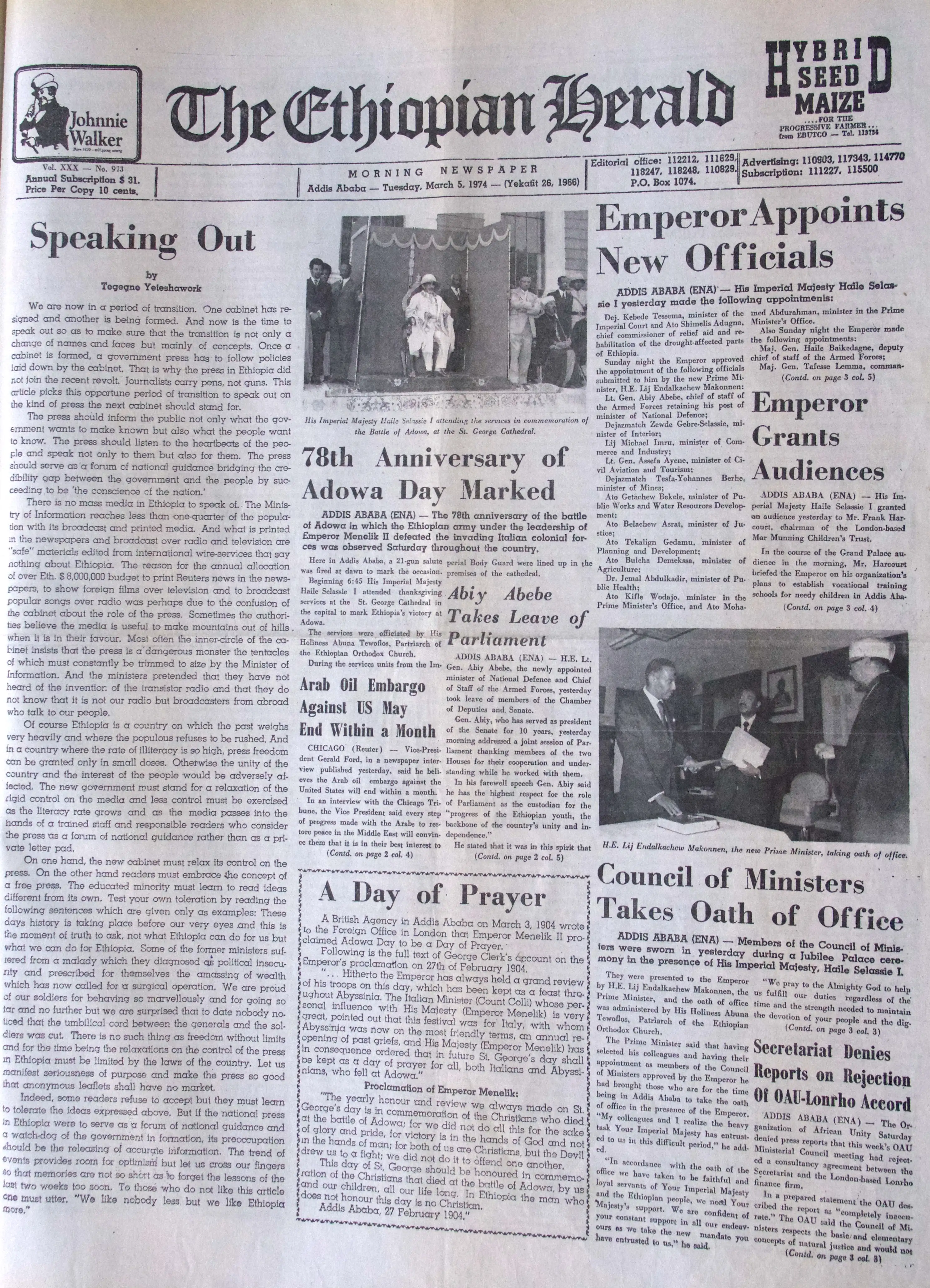
A major turning point came in 1974 when the Ethiopian Revolution ended the imperial government and brought the Derg military administration to power. Like many state-owned media institutions, the Ethiopian Herald underwent substantial changes in editorial direction. Its content increasingly reflected the socialist ideology promoted by the new government. News reports focused heavily on revolutionary programs, land reform, nationalization, literacy campaigns, and military activities. Although the newspaper continued to provide important information about national events, its editorial independence became more limited due to strict government control over the media.
The 1980s were characterized by major political and economic hardships, including the famous drought that caused lots of losses as well as protracted internal conflicts. However, despite all those hard days, the Ethiopian Herald continued publication, overcoming the enormous challenges. It continued to document government policies, international humanitarian assistance, agricultural campaigns, and diplomatic relations in conformity with the national interest. The newspaper also reported on Ethiopia's participation in international organizations and global affairs. While many of its reports reflected official perspectives, its archives remain valuable historical records for researchers studying this period of Ethiopian history.
Another major transformation occurred in 1991 when the Ethiopian People's Revolutionary Democratic Front (EPRDF) came to power after the fall of the Derg. Ethiopia adopted a federal system of government and introduced constitutional reforms that recognized greater political pluralism. The Ethiopian Herald adjusted to the changing political environment by broadening its coverage of economic development, regional affairs, investment opportunities, education, environmental issues, tourism, and social development. The newspaper increasingly highlighted Ethiopia's economic growth strategies and infrastructure projects while continuing to report on national and international events.
During the first two decades of the twenty-first century, Ethiopia experienced rapid economic expansion accompanied by significant investments in roads, railways, hydroelectric power, industrial parks, education, and healthcare. The Ethiopian Herald devoted extensive coverage to these development initiatives. It reported on major projects such as the Grand Ethiopian Renaissance Dam (GERD) and the diplomatic, financial, and political challenges Ethiopia had to overcome. The newspaper also reported extensively on improvements made on transportation infrastructure, agricultural modernization, and efforts to reduce poverty. Business reporting became increasingly important as Ethiopia sought to attract foreign direct investment and expand international trade. Tourism and mining, as well as the country’s stride in introducing modern means of agro-industry, have been reported as export items.
The rise of digital technology dramatically changed the media landscape around the world, including Ethiopia. Like many traditional newspapers, the Ethiopian Herald adapted by developing an online presence alongside its printed editions. Readers gained access to news through websites, mobile devices, and social media platforms. Digital publishing enabled the newspaper to reach millions of readers both inside Ethiopia and throughout the Ethiopian diaspora. This transition represented one of the most significant milestones in the newspaper's history, allowing it to remain relevant in an increasingly competitive information environment.
In recent years, the Ethiopian Herald has continued covering major national developments, including political reforms, elections, economic policies, peace initiatives, environmental conservation, tourism promotion, and regional diplomacy. The newspaper has reported extensively on Ethiopia's efforts to strengthen regional cooperation in the Horn of Africa while also highlighting the country's cultural diversity, historical heritage, and economic potential. It has published interviews with government officials, business leaders, academics, artists, athletes, and ordinary citizens, offering readers a broader understanding of contemporary Ethiopian society.
One of the newspaper's greatest strengths has been its contribution to national development. For more than eight decades, it has educated readers about public policies, health awareness, environmental protection, education, technological innovation, and economic opportunities. Through editorials and feature articles, it has encouraged public discussion on issues affecting the country's future. It has also helped communicate Ethiopia's perspectives to international audiences, making it an important instrument of public diplomacy.
The Ethiopian Herald has also played an important role in preserving Ethiopia's historical memory. Its archives contain thousands of articles documenting major events such as state visits, elections, constitutional reforms, economic programs, cultural festivals, sporting achievements, scientific discoveries, and humanitarian responses. Historians, journalists, researchers, and students frequently consult these archives when studying Ethiopia's modern history. In this sense, the newspaper functions not only as a source of daily news but also as a valuable historical record.
Despite its achievements, the Ethiopian Herald has faced numerous challenges over the years. Political transitions, economic pressures, changing media consumption habits, technological disruption, and increasing competition from private media outlets and digital platforms have required constant adaptation.
Like many newspapers worldwide, it has had to balance maintaining high journalistic standards while responding to rapidly changing audience expectations. The growth of social media has also increased the need for accurate fact-checking and responsible journalism to combat misinformation and fake news.
Looking ahead, the future of the Ethiopian Herald depends on its ability to continue embracing innovation while preserving its long-standing reputation. Expanding multimedia journalism, improving digital accessibility, engaging younger audiences, and strengthening investigative reporting will be essential for maintaining its relevance. At the same time, protecting professional ethics, factual accuracy, balanced reporting, and editorial credibility will remain fundamental responsibilities.
As the Ethiopian Herald celebrates 83 years of publication, it stands as a symbol of resilience, continuity, and national service. From the aftermath of liberation in 1943 to the digital era of the twenty-first century, the newspaper has witnessed nearly every major chapter of Ethiopia's modern history. It has informed citizens, documented national achievements and challenges, connected Ethiopia with the wider world, and contributed to public understanding of important national issues.
In conclusion, the Ethiopian Herald occupies a unique place in Ethiopia's media landscape, reflecting the country's dynamic and often tumultuous political and economic evolution and socio-economic development and transformation, besides its ever-expanding engagement with the international community and its readers. Despite whatever challenges it had to go through, the newspaper has remained committed to informing the public while relentlessly recording Ethiopia's trajectory of growth and progress. At the same time, the Ethiopian Herald has remained faithful to its image of a respectable medium that has continued in its existence without withering away as many newspapers have had to, given the dire media environment and the challenges of the expansion of social media and the so-called citizen journalism.
In a world where the line between journalism and activism is getting more and more blurred, the Ethiopian Herald has tried to be as relevant and informative as possible, becoming an all-rounded paper with its increasingly improving and changing format and content with new headings and titles, with external contributors and the input of famous people who might have a say in what is going on in Ethiopia as well as at the international level with a particular focus on the geopolitics of the Horn of Africa.
Given that Ethiopia is a key country in the African socio-political and diplomatic landscape, the Ethiopian Herald cannot be indifferent to developments in every part of the continent and hence deals with African issues and the challenges many countries face, especially in their relations with the Northern Hemisphere countries. It has often invited experts to express their views and feelings and contributed to the literature of research and academia and informed thoughts that illuminate the discussions on various relevant issues. Hence, the Ethiopian Herald is more than a simple newspaper but a standard bearer of the entities Ethiopia and Africa, trying to be a true reflection of the reality on the ground.
The Ethiopian Herald will remain an important voice in representing the true image of Ethiopia as well as the rest of Africa and try to project to the world that not everything the international media publish about Africa is necessarily factual and hence credible. The Ethiopian Herald clearly cannot obscure or neglect the national interest of Ethiopia in the name of presumed neutrality because there cannot be compromises on national interest or sovereignty. The paper will always argue in favor and in defense of the national interest of the country, projecting an image of optimism and a bright future for Ethiopians by underlining the major priorities of the country and how to realize them soon.
While celebrating its 83rd anniversary of establishment, it realizes that it can be better in the future going along with the changing times and changing cultural and technological advancements so that it remains not only relevant but also able to stand up to any form of competition in the field. The Ethiopian Herald will remain the standard bearer of Ethiopian journalism, and that is why the audience of readers is expected to demand more excellence and relevance to their desires. Congratulations to the Ethiopian Herald, a symbol of longevity and resilience!