
By: Goshu Melisew
Experts and policymakers have called for urgent and coordinated action to address the growing impacts of climate change on agriculture, livelihoods, and public health on human beings during a multi-stakeholder advocacy and technical workshop held in Addis Ababa.
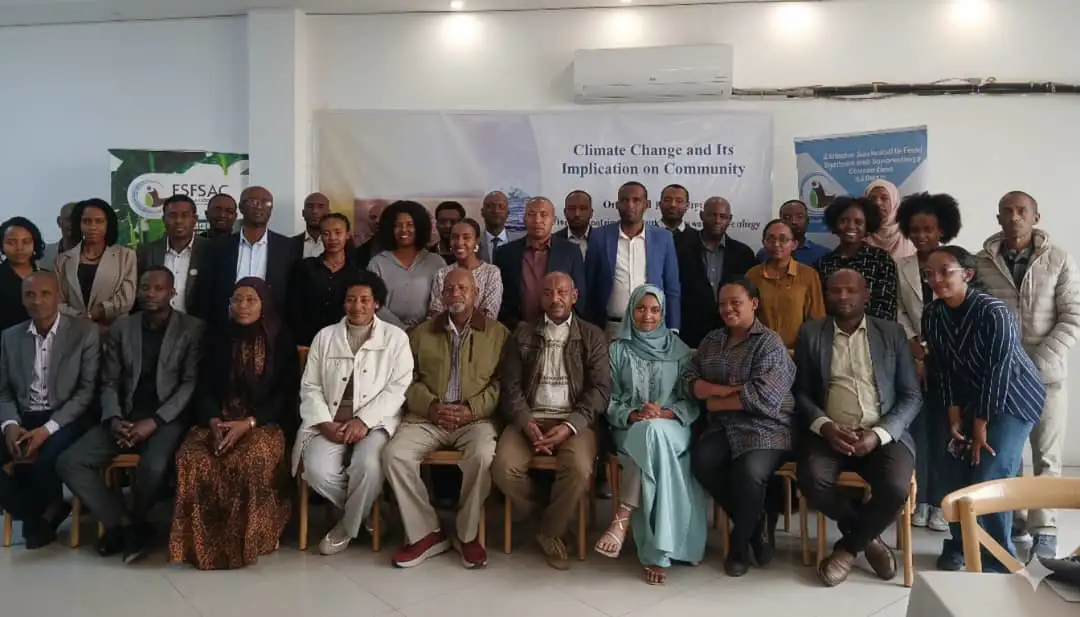
The workshop, organized by the Ethiopian Sustainable Food Systems and Agro-ecology Consortium (ESFSAC) in collaboration with PHE Ethiopia, brought together government officials, researchers, civil society organizations, and development partners to discuss climate risks and sustainable solutions.
The Executive Director of the Ethiopian Sustainable Food Systems and Agro-ecology Consortium (ESFSAC), Bayush Tsegaye (PhD), remarked that climate-resilient food systems and agro-ecological approaches are critical to strengthening community livelihoods and ensuring long-term sustainability.
Professor Messay Mulugeta from Addis Ababa University said climate change is no longer a future concern but a reality already affecting humans.
Messay highlighted Ethiopia’s Green Legacy Initiative, launched by Prime Minister Abiy Ahmed, as a key intervention contributing to agro-ecology and climate change mitigation. However; the Global Warming is affecting Ethiopia despite the country exerting efforts to fight climate change.
“Tree planting and ecosystem restoration are among the most effective actions to mitigate climate change. The Green Legacy Initiative is one of the most promising efforts we have,” he said, while stressing the need for continued vigilance and proactive measures.
"Despite government initiatives showing improvements in rainfall distribution in Ethiopia, research indicates that the country’s temperature is rising by 0.3°C per decade due to global warming. If this trend continues, temperatures could increase by up to three degrees Celsius within a century, which would have severe consequences for agriculture and livelihoods, he said.
On the role of agro- ecology and sustainable food systems, Prof. Messay explained that conserving forests, water resources, wetlands, and biodiversity directly contributes to climate mitigation.
“When we protect rivers, forests, and soils, we are taking positive actions that reduce the impacts of climate change,” he said.
He also emphasized the need to review and align environmental and agricultural policies with realities on the ground, expand national awareness, and design more practical, community-focused initiatives.
He further described Ethiopia’s opportunity to host COP32 as a critical platform to strengthen awareness, review policies, and build global collaboration on climate action.
Addressing the health dimension, Abebe Mera, Program Manager for Climate and Environment at PHE Ethiopia, said climate change and climate variability are already affecting public health.
He also highlighted the disproportionate impact of climate change on women and girls, especially in relation to reproductive health and gender-based violence.
According to Abebe, Ethiopia has developed several strategies to address climate-related health challenges, including the Climate-Resilient Green Economy Strategy, National Adaptation Plans, updated Nationally Determined Contributions (NDCs), and climate-responsive health policies.
“Although the strategies exist, weak institutional capacity and low awareness at local levels continue to hinder effective implementation,” he said, noting that PHE Ethiopia is working closely with the government to strengthen institutional arrangements and enhance community-level engagement.
Participants at the workshop agreed that integrating climate action with agro-ecology, health, and gender-responsive approaches is essential to building resilient communities and ensuring sustainable development in Ethiopia.