By: Bethel Etefa
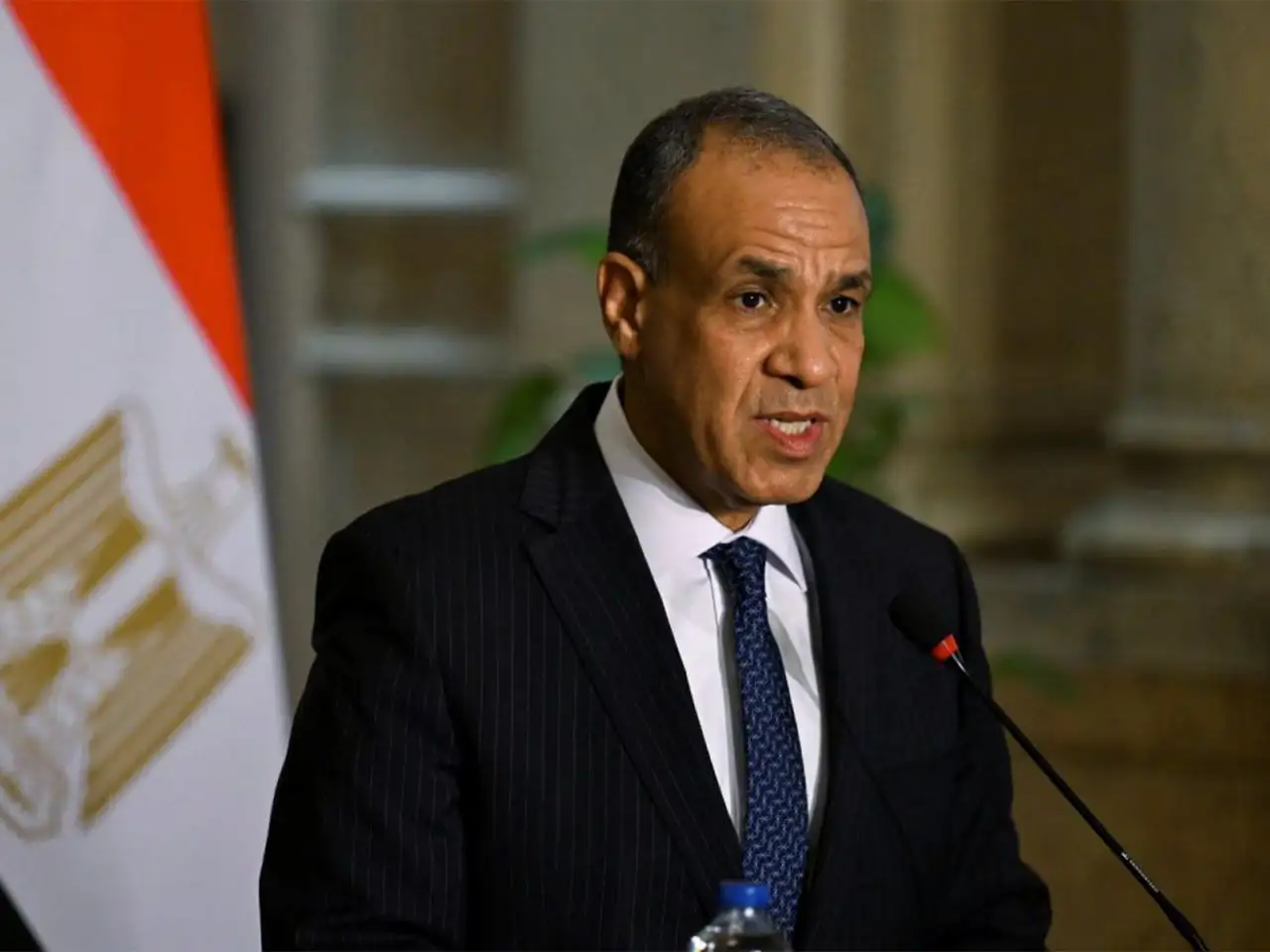
Egyptian Foreign Minister Badr Abdelatty has again cast Ethiopia's use of the Nile in confrontational terms, telling the UAE-based outlet The National that water security is an "existential threat" to Egypt—one he says ranks above conventional national security concerns. The remarks came during an interview on On The Record with Hadley Gamble, published August 25, 2026, in which Abdelatty addressed a range of regional issues, from Gaza and Iran to Sudan's refugee crisis, before turning to the Grand Ethiopian Renaissance Dam (GERD) and Ethiopia's broader hydropower plans on the Abbay (Blue Nile). Taken at face value, the interview reads as a serious escalation. Set against the legal record, the negotiating history, and the dam's actual operating record since completion, several of the minister's central claims look considerably less solid.
What Abdelatty Said
The minister described the water file as categorically different from Egypt's other regional challenges, saying it carries an "existential nature" that places it above ordinary security concerns. He argued that Egypt's near-total dependence on the Nile leaves it acutely exposed, citing basin-wide rainfall figures—roughly 1,600 billion cubic metres falling across the Nile basin each year, of which he said Egypt receives only a small fraction, against a far larger volume of annual rainfall inside Ethiopia itself.
He also laid out Egypt's domestic water arithmetic: an annual demand of around 94 billion cubic metres against a Nile share that covers only about 60 percent of that figure, with the shortfall made up through recycling and growing more acute as Egypt's population expands by roughly 2.5 million people a year.
On the diplomatic track, Abdelatty said that after 13 years without a resolution, Cairo now considers negotiations with Ethiopia to be at a stalemate. He pointed to the collapse of the February 2020 negotiations in Washington, saying Ethiopia "backed off" from a deal Egypt had already accepted. Most pointedly, he invoked Article 51 of the UN Charter—the provision governing the right to self-defence—saying Egypt reserves the right to act if the river's flow is ever interrupted.
A note on the rainfall figure: The basin-wide comparison Abdelatty offered is a common talking point in Cairo's messaging, but it measures something different from what it implies. Most of the roughly 1,600 billion cubic metres that falls across the wider Nile basin each year is lost to evaporation and soil absorption long before it could ever reach the river channel; it was never, and was never going to be, water available to either country. Comparing raw basin rainfall to Egypt's share of actual river flow makes the disparity look larger than the hydrology supports.
What the 2020 Washington Collapse Actually Involved
Framing the 2020 breakdown as Ethiopia simply "backing off" skips over why Ethiopia walked away. Ethiopia's Ministry of Foreign Affairs and Ministry of Water, Irrigation and Energy said at the time that the US-drafted text was not the product of actual trilateral negotiation, but rather one finalized between Washington and Cairo after Ethiopia asked for more time to consult domestically. Ethiopian officials argued the draft went beyond technical filling and operating guidelines to effectively lock in permanent minimum-release obligations—water Ethiopia would have to release regardless of actual inflow, including during drought years—which they said amounted to a disguised water-allocation arrangement protecting Egypt's long-claimed 55.5 billion cubic metre annual share. Ethiopia noted this would have significantly cut GERD's power-generation capacity and treated a domestic hydropower project as subject to a permanent downstream veto. Egypt initialed the draft, while Ethiopia did not attend the final round and rejected the outcome in a formal statement days later.
Two Competing Frameworks
Egypt's public position continues to lean on the 1929 and 1959 Nile Waters Agreements—colonial- and post-colonial-era arrangements that allocated the river's flow between Egypt and Sudan without upstream states, including Ethiopia (which was never a party to either agreement), at the table. Ethiopia, along with several other upstream Nile Basin states, has long rejected these agreements as binding on non-signatories and backs the 2010 Nile Basin Cooperative Framework Agreement (also known as the Entebbe Agreement) instead.
All three countries—Ethiopia, Egypt, and Sudan—did jointly sign the 2015 Declaration of Principles on the GERD, which commits them to the "equitable and reasonable utilization" of the Nile and to avoiding "significant harm" to one another. Under general international watercourse law, however, "no significant harm" functions as one factor to be weighed against a state's right to equitable use, not an automatic veto that lets a downstream state block an upstream state's development. Ethiopia's legal position rests on this framework: that a hydropower project that stores and releases water, rather than consuming it, falls squarely within its right to reasonable use of a shared river.
What's Actually Happened Since Completion
It is also worth separating projection from record. GERD's reservoir finished filling in 2023, and the dam was formally inaugurated in September 2025. The dramatic drought scenarios Cairo has publicized—Egyptian modelling has cited a possible 20–34 percent reduction in river flow—describe a hypothetical future in which reservoir operation coincides with a multi-year drought. No such drought has occurred since the dam became operational, and no verified reduction in downstream flow to Sudan or Egypt has been reported to date. That does not make the risk imaginary; dry-year operating rules remain genuinely unresolved between the three countries. But it does mean Abdelatty's language of an ongoing "existential threat" describes a modeled worst case, not an observed one.
Ethiopia's Position
Addis Ababa's position, articulated consistently by the Ministry of Foreign Affairs and the Ministry of Water and Energy since construction began, is that GERD is a power-generation project that stores and releases water rather than consuming it, and that Egypt has repeatedly overstated the harm it poses to downstream flow. Ethiopian officials argue that casting a river-management dispute in the language of an "existential threat" and a self-defence article shifts the conversation away from a technical, resolvable question of how three states share operating rules for a common river toward one of confrontation—a framing Addis Ababa says it has never accepted and has consistently pushed back against in multilateral forums, including at the UN Security Council in 2020 and 2021.
Why It Matters
The interview lands amid a period of sharpened rhetoric from Cairo, which has separately voiced anger in recent weeks over Ethiopian plans for additional dams on the Nile system. Abdelatty's invocation of the UN Charter's self-defence provision, paired with talk of a 13-year diplomatic deadlock, is among the more pointed public statements from a senior Egyptian official on the GERD file since the dam's completion. But measured against the legal instruments both countries have signed, the disputed history of why the last serious negotiation collapsed, and the dam's actual operating record so far, the interview reads more as a restatement of Cairo's long-standing negotiating position than as evidence of a new or imminent crisis. The unresolved question of how the three countries will manage a genuine multi-year drought remains exactly that: unresolved, and worth far more sustained diplomatic attention than either side's public statements currently reflect.
Sources:
• Badr Abdelatty, interviewed by Hadley Gamble, "On The Record," The National, published August 25, 2026.
• Fana Media Corporation — Ethiopian analytical response to the interview's framing.
• GIGA Focus, "The Political Deadlock on the Grand Ethiopian Renaissance Dam" — details on the 2020 Washington draft and Ethiopia's withdrawal.
• Ethiopia Insight, "Why Ethiopia rejected the U.S.-drafted GERD deal" — Ethiopia's specific objections to the 2020 draft text.
• Borkena, coverage of Ethiopia's Feb 29, 2020 Ministry of Foreign Affairs/Ministry of Water statement.
• Atlantic Council, "Nile Basin's GERD dispute creates risks for Egypt, Sudan, and beyond" — background on the 2015 Declaration of Principles and legal framework.
• Daily Overview / Substack, dam completion and filling timeline.