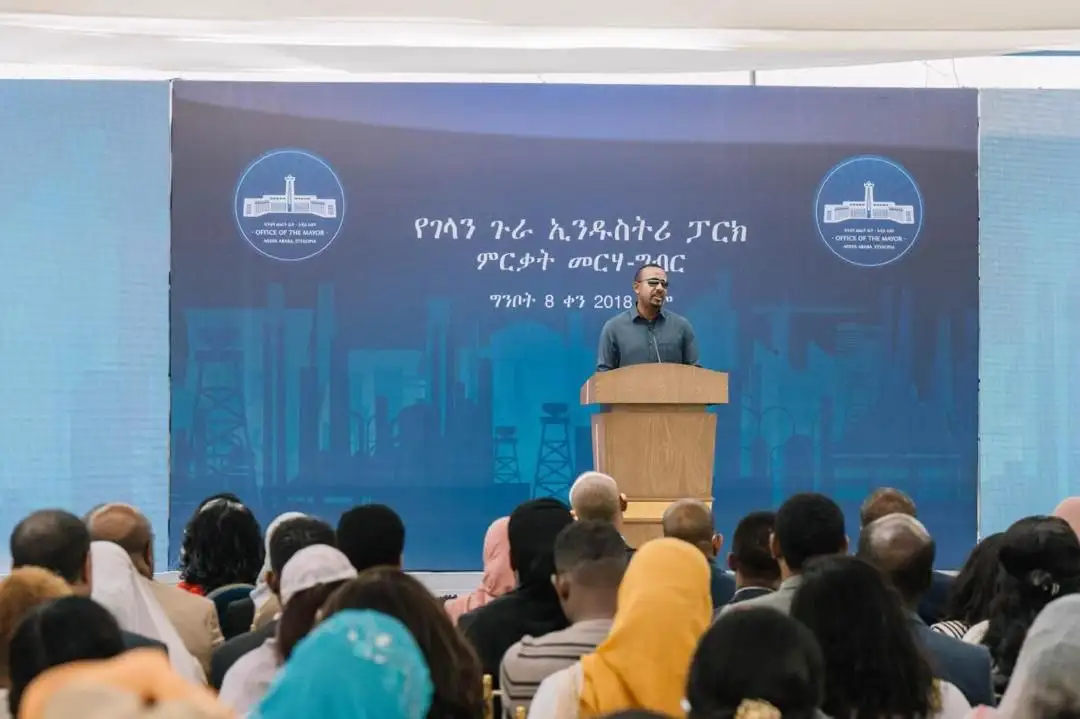
"Development that discards the poor, discards the farmer, and pushes away the needy will lead nowhere," Prime Minister Abiy Ahmed warned during the inauguration of Addis Ababa's new industrial hub connecting Bole Lemi and Goro today. Confronting the human cost of rapid modernization, the Prime Minister insisted that urban and industrial expansion must stop displacing the agricultural backbone of the country and instead turn farmers into direct business owners.
PM Abiy proposed a practical model where any farmer contributing a hectare of land for development is guaranteed a 50-to-60-square-meter commercial shop in that exact area, allowing them to immediately enter the trading system. This inclusive philosophy underpins the wider urban renewal efforts in the capital, which are designed to transition citizens away from the hardships of living on asphalt streets and into dignified, hygienic residential neighborhoods.
This grassroots focus marks a strategic pivot away from Ethiopia's historical over-reliance on foreign investment within the industrial sector. Acknowledging that industrialization is a grueling, multi-year journey requiring massive upfro nt infrastructure, the Prime Minister recalled the heavy state expenditures of past projects like the Hawassa Industrial Park. He pointed out that when economic challenges previously arose, foreign investors frequently abandoned 80 to 90 percent of industrial park properties while continuously demanding heavy tax exemptions and fee waivers.
In a triumphant contrast at the Gela Gura Industrial Park, PM Abiy celebrated the rising vanguard of local youth who, though unemployed just a few years ago, have organized into micro-enterprises, hired dozens of citizens, and are now manufacturing complex machinery—such as gold processing units, feed processors, and agricultural pumps that were previously imported. Proclaiming that Ethiopia's ultimate success lies in cultivating a generation that can "manufacture the factories themselves" rather than merely assembling foreign goods, he called on all industrialists to back these young entrepreneurs to guarantee a sustainable national return.
Maintaining this economic momentum, however, requires confronting a glaring paradox where high national unemployment coexists with severe labor shortages in critical sectors and regional developments like Wonchi, Jimma, and various sugar projects. The Prime Minister delivered a candid reality check to leaders and citizens alike, urging the nation to abandon empty rhetoric, "wake up," and pour out their sweat into a revitalized culture of hard work. Crucially, he demanded the total eradication of the "weed of theft" from all public works, warning that corruption will render the nation's collective sacrifices unprofitable.
With United Nations Secretary-General António Guterres recently forecasting a staggering 10.2 percent growth rate for Ethiopia—making it the fastest-growing economy on the continent—the Prime Minister concluded with a powerful rallying cry for unity, asserting that if citizens cultivate mutual respect across all faiths, languages, and genders, the nation is beautifully equipped to prosper and accommodate everyone.