By: Fistum Getachew
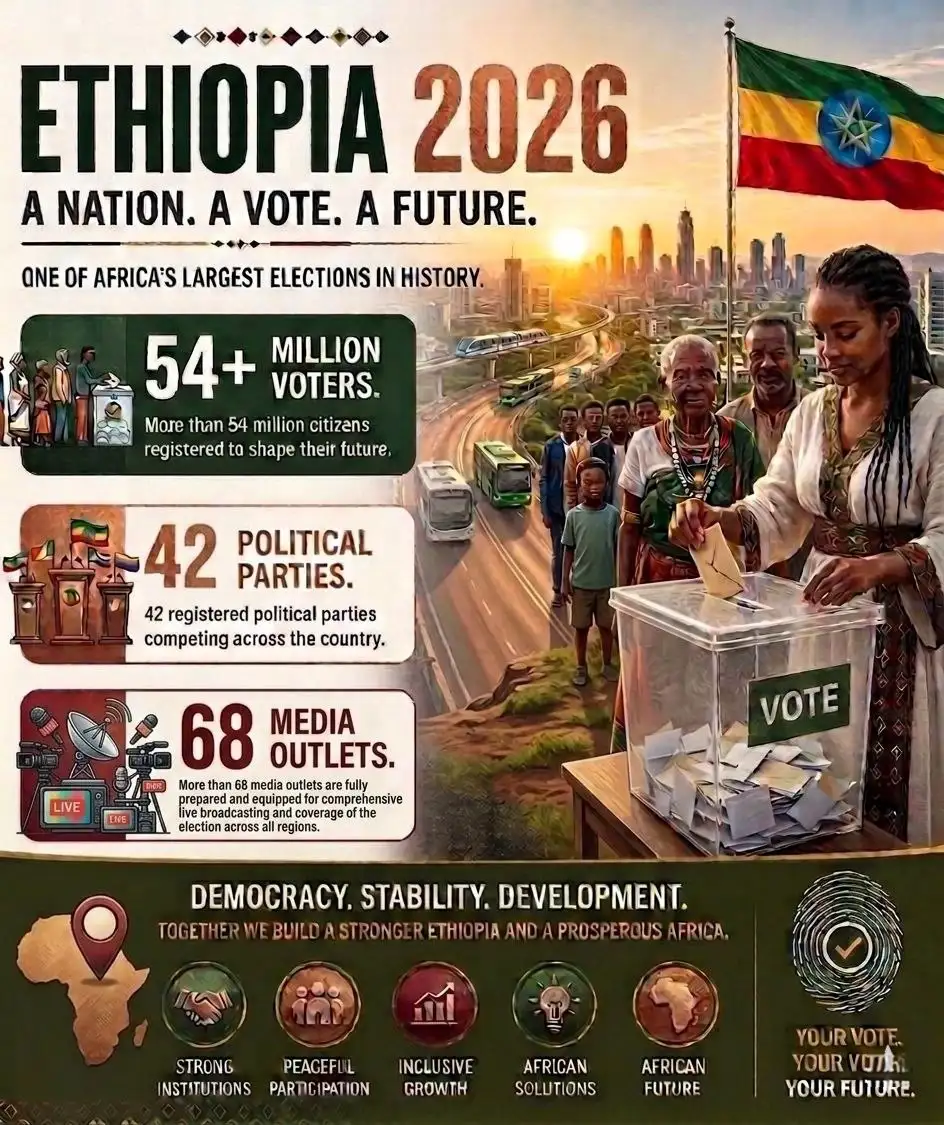
Ethiopians go to the polls on June 1, 2026 with more than fifty million voters registered to vote. It is definitely the largest number of voters to go to the polls in the country’s modern political or democratic history. Today Ethiopia is a country that has a population of more than one hundred thirty millions of whom an estimated seventy million would be eligible to exercise the right to take part in general elections as voters. Seeing that more than fifty million have registered to vote shows that people have understood the importance of the event and are committed to exercise their rights without any hesitation.
According to the National Electoral Board of Ethiopia besides the over 50 million registered voters, more than forty political parties, thousands of polling stations, and a nationwide electoral infrastructure has been organized stretching the country which is one of Africa’s largest and most diverse countries. In fact, few countries in Africa are blessed with such a wide variety of people with various cultures, languages, religions and faces across various climatic and geographical landscapes. What is more as Ethiopia is considered as the ‘land of origin’ where the human race originated, it would transmit a significant political message to the entire continent as well.
We have often heard criticisms of African elections by many forces accusing them of various deficiencies and weaknesses and yet there has been significant improvements and changes even in African electoral history as the political consciousness of citizens has increased thanks to fast exchange of ideas that inundate our social media networks. People have the information they need or would like to have at their fingertips at all times.
This digital revolution has transformed the world beyond recognition with the traditional mass media completely outshined by countless means and ways of promoting political, ideological and economic philosophies or ideas tailored to the needs and aspirations of the people of Africa according to their cultural background.
Democratic ideas have been penetrating African populations due to their exposure to multiple literature related to political thoughts. The experiences that have been shared from the practice of more advanced countries help emerging nations such as Ethiopia from committing the same blunders others have gone through and in this sense we have a lot to gain by watching what and how they have managed to achieve what they have achieved.
It is well known that democracy is a long and gradual process that cannot be perfected overnight. But it is also a process that can only be built concretely if there are all the necessary inputs not only mentally or in terms of the necessary knowledge but also in terms of institutions and infrastructure. This is because democracy needs strong and independent institutions such as an independent judiciary, strong and independent media that cannot be subdued by the executive, the exercise of the rule of law and equality before the law for all as well as a well trained and experienced body of well-educated people who can exercise the process and procedure efficiently and in a reliable manner with transparency and accountability.
Besides the necessary infrastructure, when it comes to elections is also an indispensable tool if we want to fulfill our dreams of having a democratic government that secures its legitimacy from the will and choices of the people. This would facilitate greatly the implementation of any programs of the government as there is a sense of belonging to the system and a commitment to abide by the rules that the democratic institutions such as the legislative bodies at every level of government are formed. In fact, during elections there are those at the federal level, at the regional levels, at the city level and going down to local levels all of which are elected, formed and determined by the will of the people expressed through the periodical and regular elections held in a transparent, reliable, free and inclusive manner.
Ethiopia has had several elections before this seventh one. Even before the advent of the federal institutions and the federal constitution of 1987, the country had its own history of elections beginning from imperial times spanning towards the military regime of the 1970s and 80s coming to the pre Prosperity Party era when in 2018 the reformist government replaced the EPRDF machinery. Since the foundation of the federal government in the late 1980s there have been six general elections and the one that is scheduled for June 1, 2026 is the seventh one.
This election will go down as one of the most consequential ones for the immediate and long term socio-political life of the nation because we are undergoing a critical epoch in a world full of geopolitical crises with conflicts all over the major regions of the world including the most critical ones from the standpoint of our national interest and our future development trajectory. Ethiopia finding itself at the critical position of the volatile Horn of Africa region where many super powers are often in a standoff, it needs to have a strong and fully supported government by its nationals. The results of the polls are equally importrant as the process because a democratically elected government can guide well the n at ion through these rough seas and winds. Any hesitation or indication of weakness could compromise the national sovereignty and all the national strategic interests. A well delegated government can have a big and convincing say in the relations of the country with other nations and its strength can be measured through the kind of acclamation the government can secure itself through the voice of the electorate.
Unity among nationals can give a loud and strong say not only to the government but also in front of those who deal with it. The unity of Ethiopians has always been decisive in all the battles the country had to go through in order to conserve its independence since time immemorial. The current geopolitical situation in which Ethiopia finds itself and the various complications of the world need a strong and united response based on the immediate and long term strategic interests and needs of the country.
Hence, the election of June 1, 2026 decides on this and a whole lot of other critical issues also because there are several challenges the government needs to cope with. And the results are also a strong message to other nations who are watching the polls very closely. In fact, election observation missions from the African Union and the Intergovernmental Authority on Development (IGAD) are in Ethiopia to witness the polls and their observation will have its own impact in terms of the credibility and legitimacy of the polls and on the future operations of the country not only in its internal affairs but also internationally in its relation with other nations.
Ethiopia’s role in African affairs and its diplomatic relations with a plethora of nations make this election a source of close observation. That is why Ethiopians need to make their voices heard loud and clear by casting their votes to the right parties and candidates at every level. They should elect a government that can lead them to a prosperous and peaceful path navigating through stormy seas and winds ahead.