
By: Goshu Melisew
Young Ethiopian entrepreneurs and innovators are developing practical solutions to agricultural, environmental and food-system challenges, highlighting the growing role of youth-led enterprises in Ethiopia’s transition toward sustainable food systems.
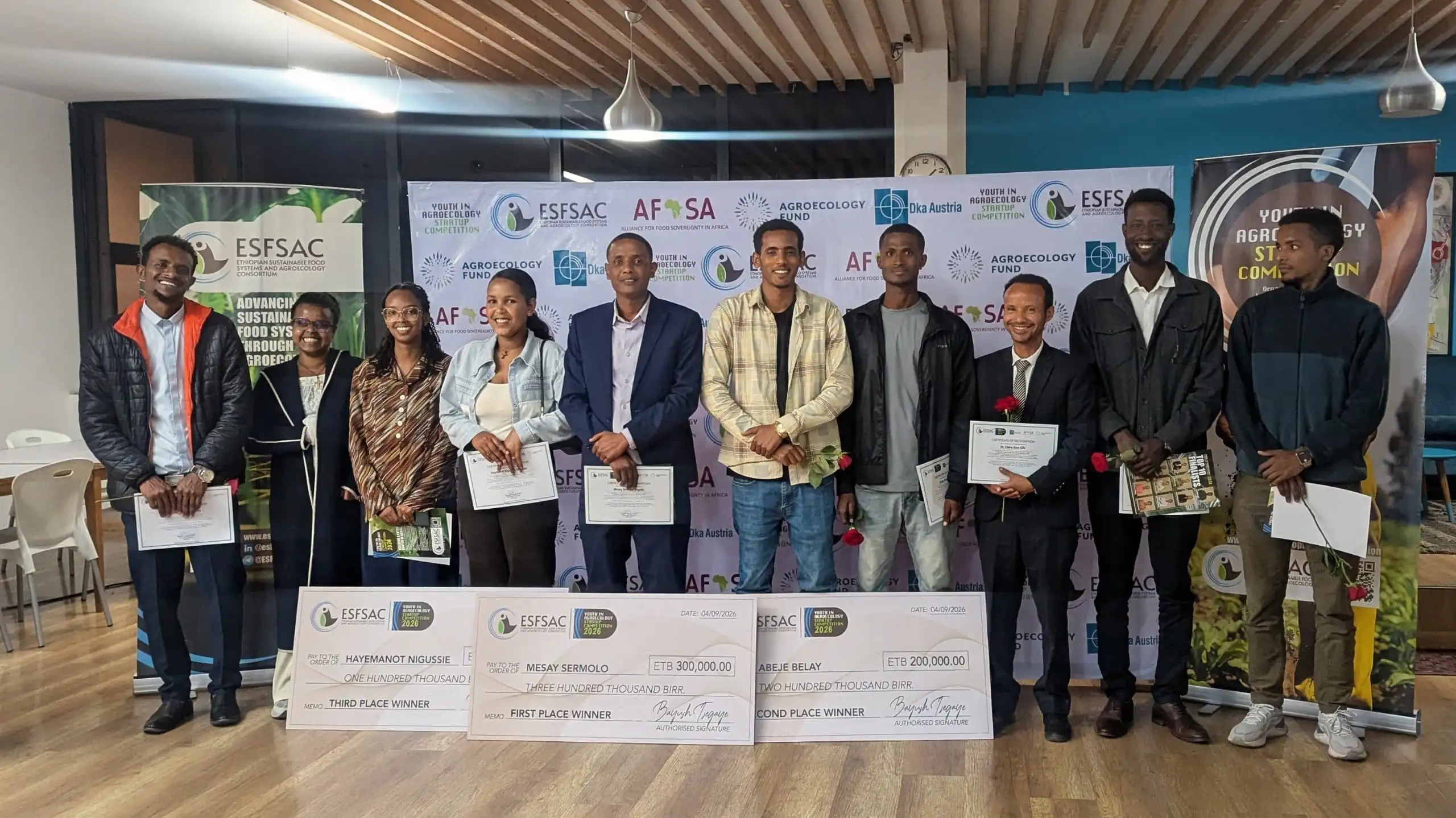
The remarks came during the 2026 Youth in Agroecology and Food Systems Competition Award Ceremony, which brought together young innovators, food-system professionals, partners and other stakeholders.
The competition was organized by the Ethiopian Sustainable Food Systems and Agroecology Consortium (ESFSAC) in collaboration with DKA Austria, the Alliance for Food Sovereignty in Africa (AFSA), and the Agroecology Fund.
Speaking at the ceremony, ESFSAC Executive Director Bayush Tsegaye (PhD) said the competition goes beyond recognizing winners by providing young people with a platform to develop practical solutions to challenges such as climate change, land degradation, post-harvest losses, limited market access and youth unemployment.
“The competition enables young people to develop practical solutions to key agricultural and environmental challenges,” Bayush said.
She emphasized that young people should be recognized as entrepreneurs, innovators, service providers, processors, traders and promoters of digital technologies across the food system.
AFSA,General Coordinator Million Belay (PhD) said agroecology is essential for protecting biodiversity and maintaining the health of indigenous food systems. He added that innovation can create jobs while introducing new technologies and business models into agriculture.
The winning innovations demonstrated how environmental and agricultural challenges can be turned into economic opportunities.
First-place winner Mesay Sermolo developed the Eco-Beeswax Press, which transforms discarded agricultural residues into valuable beeswax. He said the innovation can provide additional income for farmers while reducing reliance on imported beeswax. He plans to establish hubs in areas with strong beekeeping potential and expand access to the technology.
Second-place winner Abeje Belay developed nutritious complementary food for children by combining cereals and legumes using germination technology.
Third-place winner Haimanot Niguse developed compost using organic farming practices and locally prepared inputs, with plans to expand chemical-free vegetable production while creating economic opportunities for women.
According to ESFSAC, other promising ideas included organic inputs, recycling, bio-pesticides, climate-smart agriculture, waste-to-value enterprises, indigenous foods, eco-friendly packaging and digital marketing.
Bayush also highlighted the role of young people in advancing soil health, biodiversity, agroforestry, sustainable seed systems, land rehabilitation and circular agriculture.
The initiative aligns with Ethiopia’s food-system transformation National agenda and 2024–2040 Agroecology Strategy.
Bayush called on stakeholders to recognize young people as active leaders in building sustainable and resilient food systems.
The 2026 competition attracted 90 applicants—26 women and 64 men—from Addis Ababa and Sheger City. Following screening and evaluation by a panel of judges, 10 finalists were selected.
The first-place winner received 300,000 birr, the second-place winner 200,000 birr, and the third-place winner 100,000 birr, while the remaining finalists received 10,000 birr each.