
By: Fitsum Getachew
Ethiopia is one of the fastest growing countries in the world and with its increasing population that is more than 130 million, it is also a huge country. Ethiopia’s history tells us that it has always had access to Red Sea along its eastern coast and only since the independence of Eritrea in 1993 has it been forced into the status of a landlocked country. The manner in which it was forced to be landlocked has not been well explained or understood because it was done independently of the will or request of the Ethiopian people. People in Ethiopia do not even know in detail who exactly was the author of such a ‘disastrous story’ that benefits no one in all the sub-region and not only the countries directly involved in the contention.
The impact of being a landlocked country is enormous in its negative implications. This is even more emphatic if we consider the strategic geographic position of Ethiopia around the Horn of Africa where the entire world looks at with eagerness and interest. It finds itself along the very crucial route on international maritime landscape. So many forces have been building up assets around the Horn to be able to monitor the path along the route and secure their geopolitical interests. How can Ethiopia’s bid for access to the sea be viewed as expansionist or illegitimate?
Ethiopia naturally cannot sit back with its arms folded while distant countries come and secure a huge role in the geopolitical dynamics of the area. Ethiopia is directly affected by whatever happens in the area because it is the life line of its economy at stake. Ethiopia is projected to grow relentlessly thanks to the economic reforms carried out lately and the commitment of the government to achieve prosperity in the next few years extricating the population from poverty and want. In this regard any potential obstacles to this trajectory would not be tolerated because in the long run it puts the very survival of the nation at risk.
The absence of direct access to sea can thus be taken as an existential threat for Ethiopia. Prime Minister Abiy Ahmed (PhD) has reiterated this statement on many occasions. He has said that the time has come for Ethiopia to leave no stone unturned to secure itself a safe and independent access to the sea without encroaching on the interests and rights of others. This is because today access to sea for Ethiopia is not only an economic necessity but also an issue that can potentially infringe on its security and sovereignty in a very volatile region such as the Horn of Africa.
Ethiopia cannot afford to continuously rely on the will of other countries for its international relations that could determine its trade and commercial relations. Such reliance on others has deeply influenced its economic trajectory, geopolitical relations, and development strategies. It has created a hindrance for the full exploitation of its growth.
It should be added that the question of sea access is not merely a matter of geography but a matter of economic efficiency that reduces costs in logistics, efficiency and easy access to transportation of all the products that are to be exported from Ethiopia to foreign destinations and the easy and cost effective imports of all the products that come from abroad.
It is well known that Ethiopia’s economy heavily relies on imports and exports and the more the cost of transportation, the more affected is the economy negatively and bear on the cost of living of nationals and the limited growth of the economy. In order to continue growing and provide adequate employment for the nearly two million new births every year, Ethiopia has no alternative but to increment its growth rate commensurate with the needs of its population.
Any development to the contrary could be bound to affect even the stability of the country and the entire sub-region at large. That is why it is argued that the issue of access to sea is a complex issue intertwined with economic efficiency, national security, regional diplomacy, and long-term sustainability.
Understanding the necessity of access to sea leads to well-devised and well-identified strategies aimed at obtaining or securing them. This reality has the potential of determining the future of the nation both in the positive or negative direction.
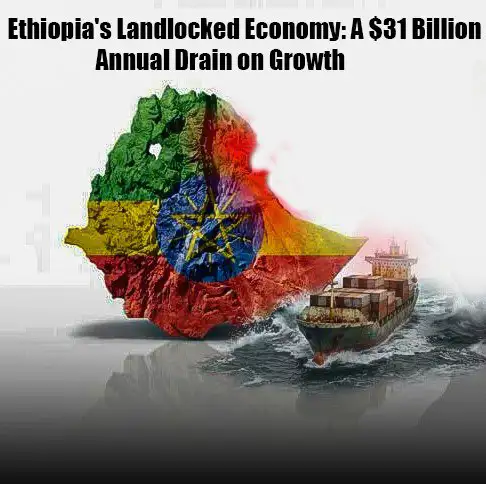
There is enough evidence to show that the necessity of sea access for Ethiopia stems primarily from economic considerations. International trade remains the backbone of modern economies, and for a country like Ethiopia—whose growth depends on exports such as agricultural products, textiles, and emerging manufacturing goods—efficient access to global markets is crucial. Experts have estimated that being landlocked significantly increases transportation costs, often by as much as 30–50 percent compared to coastal nations.
Goods must travel long distances over land before reaching ports, leading to delays, increased fuel consumption, and logistical inefficiencies. Undoubtedly this can reduce the comparative competitiveness of Ethiopian exports on the global market while at the same time increases the cost of imports, on which the country relies for its economic survival.
Ethiopia imports many items such as fuel, fertilizers, electronics and many types of gadgets and machinery, pharmaceutical and medical appliance as well as food products even if it is destined to reduce such dependency lately by producing at home. The new agricultural policy of the country gives priority to produce as much as possible with intense farming including by using extensive irrigation schemes and there has been substantial improvement in terms of amount and quality of agricultural products. The ‘Yelemat Tirufat’ or the ‘bounty of the basket’ scheme is making a marked influence in the production of food items at relatively lower prices and better quality.
Moreover, dependence on a single or limited number of transit routes creates vulnerability. Ethiopia currently relies heavily on the port of Djibouti for the vast majority of its imports and exports. While relations between Ethiopia and Djibouti have generally been stable and cooperative, overreliance on a single corridor could have its own inherent risks. There are no guarantees that there will always be political stability, and there could also arise issues of infrastructure. Economic disputes could disrupt the flow of goods, potentially leading to shortages, inflation, and economic slowdown. Diversifying access points to the sea would therefore not only reduce costs but also enhance resilience and stability.
Beyond economic factors, sea access has strategic and security implications. Maritime access allows a country to project power, protect its trade routes, and participate more actively in global and regional security frameworks. While Ethiopia maintains a strong land-based military, the absence of a robust navy limits its capacity to safeguard maritime interests. In an increasingly interconnected world, where trade routes are often subject to geopolitical tensions, having direct or guaranteed access to the sea can significantly enhance a nation’s strategic autonomy. That is why Ethiopia has been building its maritime assets and infrastructure.
It is believed that sooner or later Ethiopia would have access to sea with a diplomatic and political breakthrough. The allegations that Ethiopia intends to use force to secure access to sea have been repeatedly debunked by the authorities in Addis Ababa including the premier himself. Ethiopia’s history has no record of encroaching on the rights of other countries, nor wage wars. In fact, it has always been reputed and even commended for its contribution to the peace and stability of not only of the African continent by contributing peace keeping troops under the auspices of both the UN as well as the AU but also the world. In this respect Ethiopia’s records are enviable.
Ethiopia attaches huge importance to sea access not only economically and security wise but also in a psychological and symbolic manner. Hence the importance of sea access for Ethiopia cannot be underestimated. Historically, Ethiopia was not always landlocked and had access to the Red Sea. The loss of this access is often perceived domestically as a strategic and economic deprivation on which it had little say. We could hence conclude that addressing this issue of securing sea access has its vast economic implications but is also a matter of recovering a part of its historic national identity and enhance its aspirations as an influential country with a projection of a positive image.
Given the critical importance of sea access, Ethiopia must hence consider a range of strategies to secure it. One of the most practical and immediate approaches is strengthening diplomatic and economic partnerships with neighboring coastal states. Agreements with countries such as Djibouti, Somaliland, Sudan, and Kenya can provide Ethiopia with reliable and diversified port access. Long-term leases, joint infrastructure projects, and shared economic zones are viable mechanisms. For example, investing in port infrastructure in exchange for guaranteed access rights could create mutually beneficial arrangements. Such partnerships would allow Ethiopia to reduce dependency on a single route while avoiding the risks associated with more confrontational strategies.
Another strategy involves regional economic integration. By actively participating in regional organizations and trade agreements, Ethiopia can promote policies that facilitate the free movement of goods across borders. Improved customs procedures, standardized regulations, and coordinated infrastructure development can significantly reduce the disadvantages of being landlocked.
The development of transport corridors—such as railways, highways, and pipelines connecting Ethiopia to multiple ports—can also enhance efficiency. The Addis Ababa–Djibouti railway is an example of how infrastructure investment can mitigate some of the challenges of landlocked status, though further expansion and diversification are needed.
Economic diplomacy also plays a key role. Ethiopia can leverage its large population, growing market, and strategic importance in the Horn of Africa to negotiate favorable terms with neighboring countries. By presenting itself as an indispensable economic partner, Ethiopia can secure long-term agreements that ensure stable and cost-effective access to maritime routes. This approach requires careful negotiation, mutual trust, and a commitment to regional stability.
A more complex and sensitive strategy involves pursuing direct territorial access to the sea through political negotiation. This could take the form of land swaps, special economic zones, or internationally recognized corridors that grant Ethiopia sovereign or semi-sovereign access to a port. Such arrangements are rare and require extensive diplomatic effort, as well as the consent of the involved parties. They also demand adherence to international law and respect for national sovereignty, as any attempt to secure access through coercion or conflict would likely result in severe regional instability and international condemnation.
In parallel with external strategies, Ethiopia can adopt internal measures to reduce the disadvantages of being landlocked. Enhancing domestic infrastructure, improving logistics systems, and investing in technology can significantly increase efficiency. For instance, digitalizing customs procedures, streamlining supply chains, and developing dry ports within the country can reduce delays and costs. Additionally, promoting industries that are less dependent on bulky exports—such as services, digital technology, and high-value manufacturing—can help Ethiopia adapt to its geographic constraints.
The consequences of Ethiopia obtaining secure and diversified sea access would be profound and largely positive. Economically, reduced transportation costs would enhance the competitiveness of Ethiopian exports, attract foreign investment, and stimulate industrial growth. Improved access to imported goods would lower prices, benefiting consumers and businesses alike. Over time, this could lead to higher economic growth, job creation, and improved living standards.
Strategically, greater maritime access would enhance Ethiopia’s autonomy and influence in the region. It would reduce vulnerability to external shocks and strengthen the country’s bargaining position in international negotiations. The ability to participate more actively in maritime security initiatives could also contribute to regional stability and cooperation.
Socially, the benefits of improved economic performance could translate into better access to education, healthcare, and infrastructure for the population. Reduced costs of essential goods would particularly benefit lower-income households, contributing to poverty reduction and social equity. In this sense, sea access is not just an economic issue but a development imperative with far-reaching implications.
However, the pursuit of sea access should be done in a diplomatic manner with the principle of give and take and that is what the government has been insisting on. It has dismissed as unfounded any ambitions of Ethiopia to secure its objective by resorting to any form of coercion or use of force. There are no needs of diplomatic tensions or even conflict with neighboring countries. Any perception of aggressive intent or disregard for sovereignty could undermine regional relationships and destabilize the Horn of Africa. Therefore, Ethiopia’s approach to resolve this issue prioritizing peaceful negotiation and mutual benefit is commendable and has acquired the support of the international community.