Criticism is occasionally leveled against the extensive development projects undertaken by Prime Minister Abiy Ahmed’s (PhD) administration, with detractors sometimes claiming the focus is merely on "surface-level" or cosmetic achievements.
However, the reality on the ground demonstrates that the government’s Homegrown Economic Reform Agenda is a comprehensive, multi-sector strategy designed to develop all key economic drivers simultaneously.
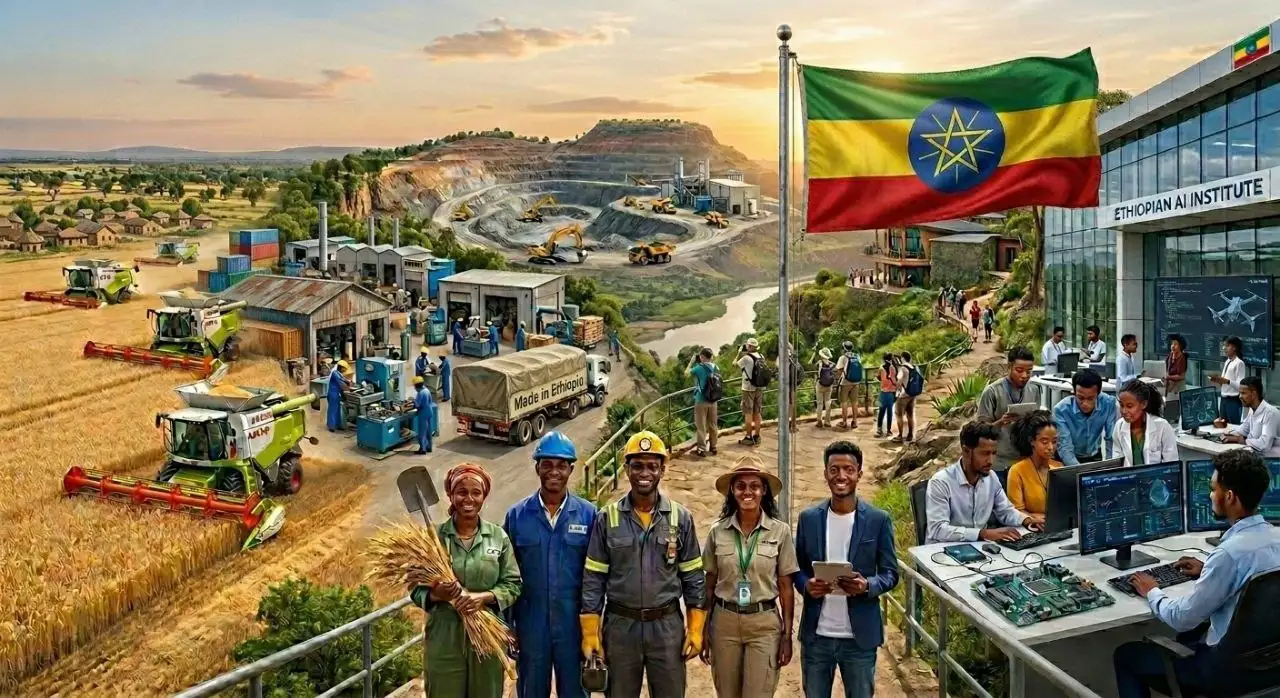
Rather than isolating a single sector, this reform actively and equally drives agriculture, manufacturing, mining, tourism, and the digital economy. This structural shift is laying a solid foundation to transition the nation's economic ecosystem from consumption to production, from import-dependency to export-led growth, and from a state-led to a private sector-driven economy.
1. Agriculture
The historic wheat revolution has successfully transitioned Ethiopia into a wheat exporter. This is underscored by national wheat production capacity reaching 305 million quintals in the 2018 Ethiopian fiscal year.
2. Manufacturing
Driven by the national "Made in Ethiopia" (Ethiopia Tamrt) campaign, the manufacturing industry has significantly boosted import substitution, which now stands at 58%. A key indicator of this success is the revival of 993 factories that had previously ceased operations but have now returned to active production.
3. Mining
Ethiopia's previously overlooked mineral resources are now receiving value-addition, transforming them into a new backbone for the economy. Thanks to legal and operational reforms, the domestic market share of coal surged from just 17% in 2010 E.C. to 75% in 2017 E.C. Furthermore, these reforms enabled gold to surpass coffee as the nation's leading foreign currency earner.
4. Tourism
The "Gebeta" (Dine for Ethiopia) projects have revolutionized the tourism landscape by creating new international destinations and expanding the tourist market. The success of this multi-sector policy is evident in the numbers: in the first nine months of this budget year alone, Ethiopia attracted 1.2 million foreign tourists, generating over $2.6 billion in revenue.
5. Technology and the Digital Economy
Following the successful completion of the "Digital Ethiopia 2025" strategy, the nation has seamlessly transitioned to the "Digital Ethiopia 2030" framework. This digital push has drastically expanded financial inclusion, with the number of digital accounts opened reaching 257.8 million by March 2018 E.C.
Concurrently, the Ethiopian Artificial Intelligence Institute is making significant contributions to the national economy. By developing localized AI systems like "Mela"—which understands indigenous languages—the institute has positioned Ethiopia as an African leader in tech. The country's breakthroughs in integrating AI into healthcare have also been recognized by the African Union, earning Prime Minister Abiy Ahmed a prestigious appointment from the union.
Macroeconomic Impact and Growth Outook
Cumulatively, the successes achieved across these five pillars have built substantial capacity to correct previous macroeconomic imbalances.
In terms of job creation, these coordinated campaigns generated over 96,000 new employment opportunities in the third quarter of 2018 E.C. alone, significantly benefiting citizens. Over the past eight years, the economy has grown at an average rate of 7.5%, and it is projected to achieve a double-digit growth rate of 10.2% in the 2018 E.C. fiscal year.
These tangible achievements firmly validate that the country is on the right path toward structural transformation and sustainable prosperity.