By: Amen Biniyam
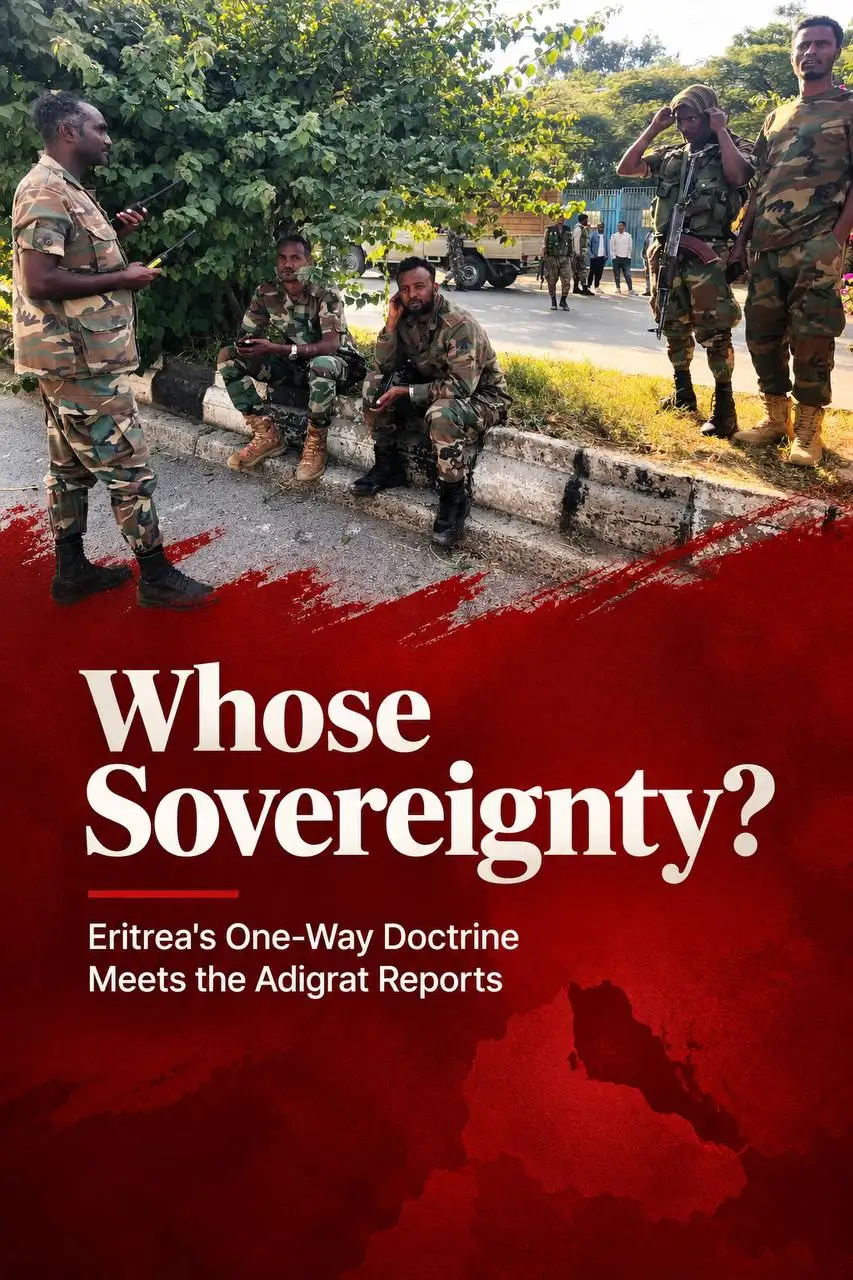
For years, Asmara has treated a landlocked neighbour's talk about the sea as an assault on its sovereignty. This week, residents of Adigrat said they watched trucks of Eritrean soldiers drive through their town, inside Ethiopia. Both things can be true at once, and the tension between them explains more about the Horn's current crisis than any troop count can. It is the point where a legal principle begins to look like a strategic instrument.
A doctrine that points in one direction
Foreign Minister Gedion Timothewos gave this contradiction a name in November 2025. Speaking at Addis Ababa University, he compared the Eritrean government to someone who wants decaffeinated coffee: the status of a sovereign state without the responsibilities that come with it. Eritrean sovereignty is treated as absolute when Ethiopian power approaches Eritrea's strategic space, and Ethiopian sovereignty as permeable whenever events in Ethiopia touch Eritrea's calculations.
The analysis rests on a pattern. It cites three decades of Eritrean support for Ethiopian armed opposition movements, the central place Ethiopia holds in Eritrean official speeches, and a chronology in which Eritrea's ties to Ethiopian armed groups predate Addis Ababa's public emphasis on the Red Sea. If that holds, the sea-access dispute is the newest vocabulary for an older contest over the balance of power in the Horn, and not its cause. Asmara rejects this characterisation and denies Ethiopian accusations that it backs the current armed alliance.
The Adigrat test
On 7 October, a local official and residents told AFP that Eritrean troops were in Adigrat, about 40 kilometres by road from the border, heading south. Reuters could not independently verify the accounts. Eritrea's information minister rejected them as a pretext for war, and reports differ on whether he denied the crossing outright. Enatalem Melese, Ethiopia's Minister of Government Communication Service, told Bloomberg that foreign forces on Ethiopian territory must withdraw, naming Eritrea.
The verification gap is real. But the analytical question does not depend on how it closes. It is what Eritrea's own doctrine would require if the reports are accurate.
Where a double standard would sit
Asmara has described Ethiopian ambitions as a plan to take ports by military invasion. Ethiopia's stated position is to seek access through negotiated arrangements and economic integration, with respect for each state's territorial integrity. An interest in the sea is not a claim to Eritrean soil, and Mamo argues that treating one as the other turns a shield into a sword. The troop reports concern physical presence on Ethiopian soil.
Eritrea has long treated Ethiopia's political configuration as a legitimate object of its security policy, while Ethiopian attention to Eritrea is labelled interference. A state cannot coherently describe its interest in a neighbour as security and the neighbour's interest in it as aggression.
Eritrean forces fought in support of the federal government in 2020–2022, and Ethiopia acknowledged their role, though it later accused them of atrocities. Reuters reports that some troops stayed near the border after the war, according to Ethiopia's government, UN experts, and human rights groups. In November 2025, Gedion said Eritrean troops already controlled several local administrations in northern Ethiopia, and that Addis Ababa was exercising restraint. If this week's reports are accurate, they may mark a move from holding positions to operating deeper. The legal baseline is not abstract between these two states. The Eritrea–Ethiopia Claims Commission found in 2005 that Eritrea breached Article 2(4) of the UN Charter through its 1998 attack on Badme.
The case against the double-standard reading
A fair assessment has to test the thesis against its weaknesses.
First, evidence. The accounts come from residents, a local official, and a militia commander who is a party to the war. Eritrea rejects the allegations. Second, motive. Eritrea fought on the federal side in 2020–2022, so the claim that Asmara now stands behind the TPLF-led coalition is an Ethiopian assessment, not an established fact. Eritrean forces, if present, may pursue their own objectives. ACLED assesses that they entered to stop Ethiopian and allied forces from reaching the border. Third, threat perception. Eritrea's fear of Ethiopian designs on its coast is part of how its leadership reads the region, and Ethiopia's public emphasis on sea access has fed it.
The standard also has to bind Addis Ababa. Gedion himself urged that rigid conceptions of sovereignty give way to economic integration. Asmara may read that as pressure, and a critique of selective sovereignty that is itself selective would carry little weight. Much of the analysis here also comes from Ethiopian official or Ethiopia-based sources, while Eritrea's account reaches outsiders mainly through ministry statements.
Why this matters beyond the bilateral
Sovereignty is a currency. It buys protection only while others believe it is applied consistently. The AU has urged restraint on all sides, and with embassies closed in both capitals, the usual channels for managing a crisis are gone. A sovereign state chooses the terms of its cooperation, and a port lease, transit corridor, or commercial arrangement would leave Eritrean sovereignty intact. But when sovereignty is used to rule out the conversation itself, it stops functioning as a shield and operates as a veto.
The Adigrat reports are therefore a test of Eritrea's argument as much as an event on the ground. If troops are present over Addis Ababa's objection, the double standard moves from rhetorical accusation to a defining feature of Eritrea's regional posture. If the reports are disproved, the Eritrean case regains much of its force. Either way, the principle will be judged by whether it is applied in both directions.
References
Timothewos, G. (2025, November 13). Speech at the Foreign Policy Forum on Developments in the Horn of Africa [Speech]. Addis Ababa University. MFAEthiopia Blog. [https://mfaethiopia.blog/2025/11/14/speech-by-foreign-minister-gedion-timothewos-at-the-foreign-policy-forum-on-developments-in-the-horn-of-africa/](https://mfaethiopia.blog/2025/11/14/speech-by-foreign-minister-gedion-timothewos-at-the-foreign-policy-forum-on-developments-in-the-horn-of-africa/)
Mamo, B. (2026, October 7). "Decaffeinated sovereignty": Eritrea's one-way street with Ethiopia. Horn Review. [https://hornreview.org/2026/10/07/decaffeinated-sovereignty-eritreas-one-way-street-with-ethiopia/](https://hornreview.org/2026/10/07/decaffeinated-sovereignty-eritreas-one-way-street-with-ethiopia/)
Ynetnews. (2026, October 2). Eritrea cuts ties with Ethiopia as rebels claim drone attack on Addis Ababa. [https://www.ynetnews.com/article/b1jsyuh9mg](https://www.ynetnews.com/article/b1jsyuh9mg)
Agence France-Presse. (2026, October 7). Eritrean troops deploy in Ethiopia's Tigray region: local official, residents. Arab News. [https://www.arabnews.com/world/eritrean-troops-deploy-in-ethiopias-tigray-region-local-official-residents-3005051](https://www.arabnews.com/world/eritrean-troops-deploy-in-ethiopias-tigray-region-local-official-residents-3005051)
Al Jazeera. (2026, October 7). Witnesses spot Eritrean troops inside northern Ethiopia as tensions flare. [https://www.aljazeera.com/news/2026/10/7/witnesses-spot-eritrean-troops-inside-northern-ethiopia-as-tensions-flare](https://www.aljazeera.com/news/2026/10/7/witnesses-spot-eritrean-troops-inside-northern-ethiopia-as-tensions-flare)
Reuters. (2026, October 7). Eritrean troops drive through northern Ethiopian town, witnesses say. ThePrint. [https://theprint.in/world/eritrean-troops-drive-through-northern-ethiopian-town-witnesses-say/3064683](https://theprint.in/world/eritrean-troops-drive-through-northern-ethiopian-town-witnesses-say/3064683)
Bloomberg. (2026, October 7). Ethiopia accuses Eritrea of incursion, demands troop withdrawal. [https://www.bloomberg.com/news/articles/2026-10-07/ethiopia-accuses-eritrea-of-incursion-demands-troop-withdrawal](https://www.bloomberg.com/news/articles/2026-10-07/ethiopia-accuses-eritrea-of-incursion-demands-troop-withdrawal)
Reuters. (2026, October 1). Eritrea severs diplomatic ties with Ethiopia after Addis Ababa orders closure of embassy in Asmara. Daily Maverick. [https://www.dailymaverick.co.za/article/2026-10-02-eritrea-severs-diplomatic-ties-with-ethiopia-after-addis-ababa-orders-closure-of-embassy-in-asmara/](https://www.dailymaverick.co.za/article/2026-10-02-eritrea-severs-diplomatic-ties-with-ethiopia-after-addis-ababa-orders-closure-of-embassy-in-asmara/)
Al Jazeera. (2026, August 7). Northern Ethiopia's shifting alliances explained. [https://www.aljazeera.com/news/2026/8/7/northern-ethiopias-shifting-alliances-explained](https://www.aljazeera.com/news/2026/8/7/northern-ethiopias-shifting-alliances-explained)
Eritrea–Ethiopia Claims Commission. (2005, December 19). Partial Award, Jus Ad Bellum: Ethiopia's Claims 1–8. Reports of International Arbitral Awards, 26, 457–469. United Nations. [https://legal.un.org/riaa/cases/vol_XXVI/457-469.pdf](https://legal.un.org/riaa/cases/vol_XXVI/457-469.pdf)
Capital FM. (2026, October 2). Ethiopia and Eritrea cut diplomatic ties as northern conflict escalates. [https://capitalfm.africa/ethiopia-and-eritrea-cut-diplomatic-ties-as-northern-conflict-escalates/](https://capitalfm.africa/ethiopia-and-eritrea-cut-diplomatic-ties-as-northern-conflict-escalates/)
Agence France-Presse. (2026, October 8). Eritrean troops deployed in Ethiopia's Tigray region. The Express Tribune. [https://tribune.com.pk/story/2633644/eritrean-troops-deployed-in-ethiopias-tigray-region](https://tribune.com.pk/story/2633644/eritrean-troops-deployed-in-ethiopias-tigray-region)