By: Shiferaw Lakew
Namaste,
Perhaps you've heard this warm and graceful greeting in films — a gentle gesture of welcome, hands pressed together, eyes shining with sincerity. Like many, my first glimpse of India came through its cinema — vibrant stories filled with color, music, and emotion. For a long time, that was the extent of my understanding — a South Asian nation seen through the lens of art and imagination. I carried a picture in my mind shaped more by movies than reality. Thus, my image of this vast, fascinating country was a place painted in bold strokes by Bollywood. Beautiful, yes. But distant. Imaginative. Almost dreamlike.
And now?
Now, I’m here to discover what lies beyond the screen. To trade movie scenes for street scenes, and scripted lines for real conversations. To walk through the chaos and charm, to feel the heartbeat of a culture that’s as ancient as it is alive. India isn’t just a story you watch — it’s a world you step into. And I’m ready to see it with open eyes, and an open heart.
Journey to New Delhi
When I boarded the plane to India, I expected insight. What I did not expect was transformation of such a scale. Over the course of a week in New Delhi, Agra and Bengaluru—as part of a delegation on a familiarization visit of media journalists from West Asia & North Africa, organized by the Indian Ministry of External Affairs (MEA)—I witnessed not just a country, but a phenomenon. A nation bursting with contrasts, where ancient temples stand beside AI labs, and rickshaws hum past rocket launch pads. India is not merely evolving—it is accelerating, reshaping what it means to develop in the 21st century.

New Delhi: A Legacy of Civilization and Cooperation
New Delhi, India’s capital. It serves as both the political heart and cultural compass of the nation. Here, time feels layered — the present thrives while the past remains ever watchful. A city where the echoes of empires whisper through grand boulevards and ancient stone. Here, the golden haze of morning filters through the domes of Humayun’s Tomb, as cycle rickshaws hum past colonial-era mansions and bustling chai stalls.
At its heart stands India Gate, proud and solemn, while the Rashtrapati Bhavan presides atop the majestic Rajpath, flanked by wide lawns and whispering neem trees. Markets like Chandni Chowk swirl with color, chaos, and spice—where the air is thick with the scent of marigolds, street food, and history. From the serenity of the Lotus Temple to the dazzling modern skyline of Connaught Place, New Delhi is a rich tapestry—a city forever poised between the past and the possible.
The city is not only a repository of rich historical and cultural heritage but also a hub of intellectual and policy-driven activity. Among its many esteemed institutions is the Observer Research Foundation (ORF), an independent global think tank that conducts rigorous research, fosters inclusive dialogue, and invests in the development of emerging thought leaders. Over the past decades, ORF has played a key role in narrating and influencing India’s transformation. Evolving from a domestic policy think tank to a global platform, it now contributes to building policy consensus and advancing India’s engagement with the world.

The media delegation brief by ORF has highlighted Ethiopia’s growing importance and emphasized plans for enhanced collaboration with this key East African nation.

RITES Ltd (Rail India Technical and Economic Service)
RITES Ltd, formerly known as Rail India Technical and Economic Service Limited, is a leading Indian public sector enterprise and engineering consultancy specializing in transport infrastructure. Established in 1974 under the aegis of Indian Railways, RITES initially focused on providing consultancy services in rail transport management both within India and internationally.
Over the years, the company has significantly expanded its portfolio to include planning and consulting services across various infrastructure sectors, including airports, ports, highways, and urban development. As of 2011, RITES has successfully executed projects in over 62 countries, reinforcing its global footprint and expertise in infrastructure development. As it is celebrating over 50 years of excellence, it has adopted a future forward mantra, ADAPT, to strengthen its position as a GO-TO infrastructure consultancy in India and globally. ADAPT stands for Acknowledge, Develop, Align, Partnership, and technology.

Dilli Haat INA: A Living Canvas of Indian Handicrafts
Tucked away in the heart of the capital, this unique market is a vivid tapestry of India’s rural charm and cultural richness. With its traditional ambiance and colorful stalls, it beautifully recreates the aura of a rustic Indian haat, drawing visitors into a world where heritage meets craftsmanship.
As one of the largest and most renowned permanent craft markets, it serves as a thriving hub for artisans and traders from across the country. Here, you’ll find exquisite sandalwood and rosewood carvings, intricate metal and brassware, and handcrafted jewelry adorned with sparkling gems. Leather footwear, home décor, and a variety of contemporary crafts sit side by side with timeless traditional wares.
CII: The Confederation of Indian Industry
The Confederation of Indian Industry (CII) is a non-governmental trade association and advocacy group headquartered in New Delhi, India. Established in 1895, CII brings together leaders from business, politics, academia, and civil society to shape global, regional, and industrial agendas. It is a membership-based organization registered under the Societies Registration Act of 1860.
CII’s highest governing body is the CII National Council, comprising prominent industry leaders and experts. The organization operates through more than 500 intellectual groups—such as councils, committees, task forces, and working groups—active at both national and regional levels across various industry sectors. These groups represent member interests, engage with government policymakers, regulators, and think tanks, and proactively contribute to policy formulation aimed at empowering businesses.
The Coalition for Disaster Resilient Infrastructure (CDRI)
The Coalition for Disaster Resilient Infrastructure (CDRI) is a global partnership of national governments, UN agencies and programs, multilateral development banks and financial institutions, the private sector, and knowledge institutions. It aims to enhance the resilience of both new and existing infrastructure systems against climate and disaster risks, supporting the broader goals of sustainable development.
CDRI advocates for the rapid development of resilient infrastructure to meet the Sustainable Development Goals, particularly in expanding universal access to basic services, fostering prosperity, and promoting decent work. The coalition offers a wide range of services, including disaster response and recovery support; assistance in innovation, institutional and community capacity building; standards and certification; collaborative research; flagship global reports; and a comprehensive global database on infrastructure and sectoral resilience.
Equipped with multi-hazard early warning systems, CDRI has expressed a desire to expand its membership. Several countries and organizations have already joined the initiative, including the African Union (AU).

Discussion with Secretary (CPV) and Joint Secretary (WANA), MEA
While officially welcoming the journalists, Arun Kumar Chatterjee, Secretary (CPV & OIA) in the Ministry of External Affairs of India reiterated that his country is Africa’s fourth-largest trading partner, with trade volumes nearing US$ 100 billion. Indian investments have reached approximately US$ 75 billion, spanning sectors such as information technology, pharmaceuticals, automotive industries, mining and banking.
He added that India was the first developing nation to offer duty-free access to Least Developed Countries (LDCs) under its Duty-Free Tariff Initiative (DFTP) initiative in 2008, and sees great potential in the African Continental Free Trade Area (AfCFTA) to further integrate Africa into the global economy. He also took the opportunity to emphasize Ethiopia's significance in the diplomatic friendship between the two countries, which encompasses a wide range of collaborations, including cultural exchanges.

Agra and the Eternal Whisper of the Taj Mahal
I had seen the Taj Mahal in pictures. But nothing prepared me for standing before it. An immense mausoleum of white marble, built in Agra between 1631 and 1648 by order of the Mughal Emperor Shah Jahan in memory of his favorite wife, the Taj Mahal is the jewel of Muslim art in India and one of the universally admired masterpieces of the world's heritage. This UNESCO World Heritage Centre is not just a structure. It’s a story. A tribute to love, artistry, and legacy. The Taj is a monument to the idea that what we build today—if built with care and vision—can last for centuries.

Bengaluru: The Tech Paradise
Bengaluru (formerly known as Bangalore), is the vibrant capital of Karnataka in southern India, is renowned as the heart of the country’s high-tech industry. Beyond its status as a tech hub, the city enchants visitors with its lush parks, dynamic nightlife, and rich cultural heritage, making it one of India's most compelling cities. Bengaluru isn't just the "Silicon Valley of India," as it's often called — it's also home to a vibrant blend of innovation, culture, and history.

Touching the Stars: A Visit to ISRO
At the Indian Space Research Organization (ISRO), I stood in awe. This was no ordinary tour. This was a revelation. We learned about Chandrayaan Program, the Mars Orbiter Mission, and India’s successful landing of the Vikram Lander on the Moon’s South Polar Region in August 2023—a feat no other country has accomplished. This wasn’t just about science. It was about audacity. It was about believing that the sky is not the limit—it’s the beginning. I asked them about their collaboration with Ethiopia. They mentioned that they are currently providing training to the country and emphasized that multiple areas of cooperation could be explored once a Memorandum of Understanding (MoU) is signed. They also noted that they are collaborating through the African Space Agency with other African countries.

Science, Innovation, and Research: Shaping the Future
The Indian Institute of Science (IISc) is a public, deemed, research university for higher education and research in science, engineering, design, and management. It is located in Bengaluru, Karnataka. The institute was established in 1909 with active support from Jamsetji Tata and thus is also locally known as the Tata Institute. It was granted a deemed university status in 1958 and recognized as an Institute of Eminence in 2018. It is currently collaborating with two universities in Ethiopia: Jimma and Bahir Dar universities. Ethiopian students are working shoulder to shoulder with the best minds in the world at the university, bridging between our nations.

Biocon and DNA: Driving Innovations in Biotechnology
The Biocon Group is a global leader in the biopharmaceutical industry, committed to delivering high-quality, cost-effective medicines to patients across more than 120 countries. By pioneering innovative and affordable treatments for chronic conditions such as diabetes, cancer, and autoimmune diseases, Biocon continues to transform lives worldwide.
With core business verticals in Generics, Biosimilars, and Research Services, Biocon leverages its unique affordable innovation model and strong scientific capabilities to develop and manufacture both small and large molecules at a global scale. Founded in 1978 by Kiran Mazumdar-Shaw, the Group has spent over 45 years improving health outcomes and creating sustainable value for its stakeholders.
Driven by a deep sense of purpose to promote global health equity, Biocon is focused on expanding access to essential and life-saving therapies. Its state-of-the-art research, robust manufacturing infrastructure, and broad commercial reach ensure that critical medicines remain accessible and affordable for patients around the world. The Group is also focused on optimizing resources and capital efficiency to maximize its impact in Africa, with a growing presence in countries like Ethiopia.

Artpark: Where Next-Gen AI Meets Robotics and Drones
Artpark is an inspiring center of technological innovation, where science, creativity, and engineering come together. During my visit, I had the opportunity to observe scientists and researchers deeply engaged in developing advanced robotics and other cutting-edge technologies. What stood out most was their unwavering dedication and passion for pushing the boundaries of what's possible.
It wasn’t just about building machines—it was about solving real-world problems and imagining the future. From designing intelligent robots to exploring new applications of artificial intelligence, the work being done at Artpark reflects a strong commitment to progress and innovation. Witnessing their collaborative efforts and technical expertise was both impressive and motivating, offering a glimpse into the future shaped by science and technology.

Bengaluru Palace: Where History Meets Grandeur
Bengaluru Palace is a majestic historical landmark located in the city of Bengaluru, Karnataka, India. Built in the Tudor style reminiscent of medieval castles in England, it stands out with its fortified towers, battlements, and elegant wood-carved interiors. The palace was commissioned in 1878 by Maharaja Chamarajendra Wadiyar X and was inspired by the Windsor Castle in England.
Originally intended as a private residence for the royal family of Mysore, Bengaluru Palace showcases a blend of Gothic and Tudor architectural styles, featuring sprawling grounds, lush gardens, and intricate stained-glass windows. The palace has several rooms adorned with ornate paintings, antique furniture, and impressive woodwork, reflecting the grandeur of the Wadiyar dynasty.
Today, Bengaluru Palace is open to the public as a tourist attraction and also hosts cultural events, concerts, and exhibitions. Its rich history, architectural beauty, and royal heritage make it one of the must-visit places in Bengaluru for both locals and visitors.

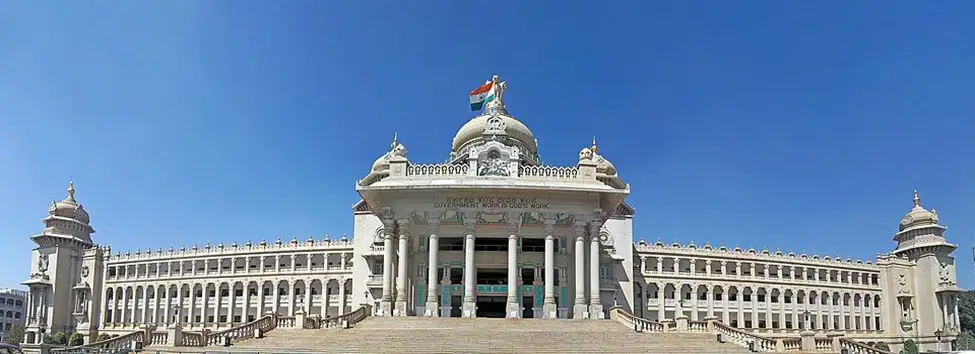
Vidhana Soudha: The Legislative Heart of Karnataka
Vidhana Soudha (also spelled Vidhāna Saudha, literally meaning "Legislative House") is the seat of the Karnataka Legislature, located in the heart of Bengaluru, India. Completed in 1956, this grand structure houses the state's bicameral legislature, comprising the Karnataka Legislative Assembly and the Karnataka Legislative Council.
Regarded as one of the finest examples of post-independence civic architecture in India, Vidhana Soudha is more than just a government building—it is a symbol of Karnataka’s political identity, architectural ambition, and cultural pride. Blending elements of Dravidian, Indo-Saracenic, and modern architectural styles, it stands as a testament to the state's aspirations in the early years of Indian independence. Its imposing granite façade, ornamental details, and strategic location make it a prominent landmark and a source of inspiration for civic structures across the country.

Ancient Roots, Rising Voices: The Shared Journey of India and Ethiopia
India — one of the world’s oldest living civilizations — stands as a breathtaking tapestry of cultures, languages, and traditions. Its history echoes through ancient temples, bustling streets, and sacred rivers. Since gaining independence, this vast and vibrant nation has risen with determination, forging remarkable progress across the social and economic spectrum. From ancient wisdom to modern innovation, India’s journey is nothing short of extraordinary. India and Ethiopia — two of the world’s oldest civilizations — stand as proud testaments to human endurance, cultural richness, and historical depth. Both nations are cradles of ancient wisdom, where history is not only remembered but lived. In India, time weaves through temples, texts, and timeless traditions; in Ethiopia, it echoes through ancient churches, royal chronicles, and centuries-old customs. Each is a mosaic of diverse ethnicities, languages, and religions, forming vibrant national identities grounded in unity through diversity.
Since gaining independence — India in 1947 and Ethiopia following the end of imperial rule in 1974 — both countries have embarked on ambitious paths of socio-economic transformation. They have tackled poverty, nurtured education, and strengthened their democratic institutions, all while navigating the challenges of modernization and global integration. Today, India and Ethiopia emerge not only as guardians of ancient legacies but also as rising voices in the global conversation, carrying with them the strength of their past and the promise of their future.