By: Demis Mekuriyaw
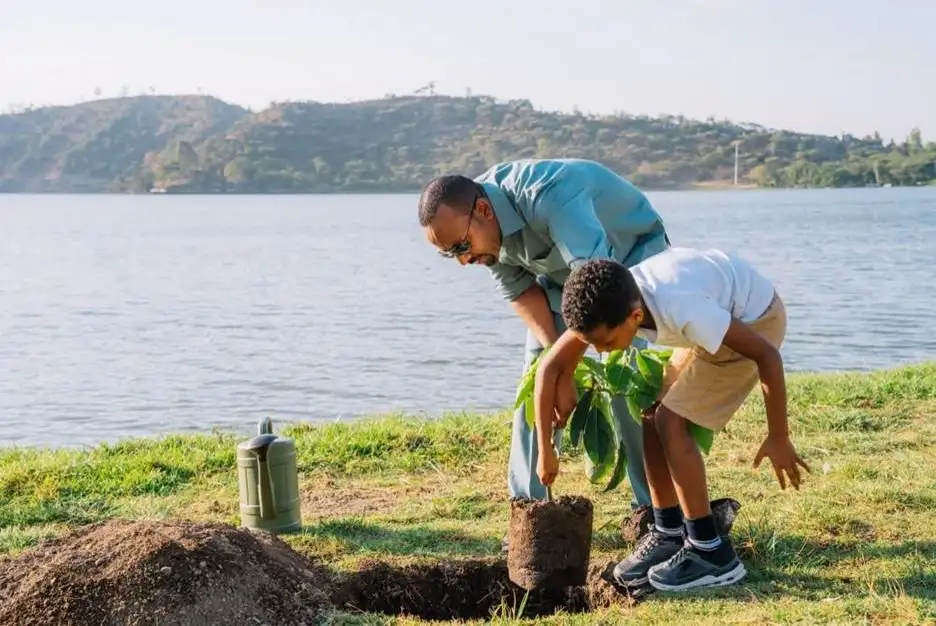
Very recently at Bishoftu, a town an hour outside Addis Ababa, Prime Minister Abiy Ahmed knelt and pressed a seedling into soil and set in motion what may be the single largest act of ecological repair attempted by any nation on earth. It was the launch of the eighth round of the Green Legacy Initiative, and by the time the 2026 planting season closes, Ethiopia expects to have placed more than eight billion new seedlings into the ground, pushing its cumulative total since 2019 past 55 billion trees. What started seven years ago as a domestic reforestation drive has, in 2026, become something far larger: the environmental centerpiece of Africa's bid to lead the world on climate.
Few government programs anywhere have moved at this scale or this fast. Fewer still have managed to fuse environmental policy with national identity the way Ethiopia has. And with Addis Ababa now confirmed to host the 32nd UN Climate Change Conference, COP32, in 2027, a project that began as one country's effort to regreen its own hillsides has been elevated into the proof point for an entire continent's climate diplomacy.

The raw numbers are striking.
According to Ethiopia's official figures, the country has planted roughly 48 billion seedlings over the programme's first seven years (2019–2025), and has beaten its own annual target every single year without exception, sometimes by as much as 20 percent.
The infrastructure behind that achievement has scaled just as fast as the headline numbers. The number of seedling nurseries nationwide has nearly tripled, from roughly 45,000 to about 120,000 and 60 percent of those nurseries are now privately owned, evidence that tree-growing has become a genuine small business sector rather than a purely state-run exercise. Ethiopia's Forestry Development Authority reports that more than 11.2 million hectares of land have been brought under planting and that an average of 25 million citizens turn out every year to take part—roughly one in five Ethiopians every single rainy season.

Students and young volunteers join a Green Legacy planting drive. Photo: Ethiopian Embassy, Pretoria
In a single twelve-hour window on 31 July 2025, an estimated 714.7 million seedlings went into the ground nationwide, a one-day mobilisation that drew participation from roughly 15 million Ethiopians, among them schoolchildren, farmers, civil servants, and visiting dignitaries from neighbouring Kenya and Somalia.
By 9:00 in the morning, 103 million seedlings were already in the ground. By 1:00 in the afternoon, the count had passed 517 million, three-quarters of the goal. By dusk, 714.7 million seedlings had been planted, a single-day record that Ethiopian officials describe as the largest of its kind anywhere in the world.

What makes these figures more than ceremonial is the trend line beneath them. National forest cover rose from 17.2 percent before the initiative's launch to 23.6 percent by 2024, a near-40-percent relative increase in six years. Independent reviewers, including the World Resources Institute and fact-checking groups such as PesaCheck, have broadly corroborated this trajectory.
Results on the Ground
Behind the seedling counts is a quieter, more visceral story: soil and water that Ethiopia had been losing for generations and has begun to win back.
Before the restoration drive intensified, Ethiopia's croplands were losing soil at a rate of roughly 300 tonnes per hectare every year, according to a baseline study by Ethiopia's Highland Reclamation Study and the FAO; that figure has fallen to about 90 tonnes per hectare today, a 70 percent reduction. Forestland soil loss fell by more than half over the same period. Most strikingly, the volume of sediment choking the country's dams and reservoirs each year has dropped from an estimated 2 billion tonnes to roughly 208 million tonnes — a 90 percent decline that directly protects the lifespan of hydropower infrastructure the country depends on for electricity and export revenue.
Nowhere is the human stake in that recovery clearer than at Lake Haramaya, in the eastern Hararghe highlands. For more than three decades the lake was the primary source of drinking water for the nearby towns of Aweday and the historic city of Harar, a place where weddings and holidays were celebrated on its banks. Over-pumping, watershed degradation, and drought dried it down to almost nothing by the mid-2000s; at one point its surface area had shrunk to barely three hectares, from roughly 550 at its healthiest. Lakeside communities have described the relapse of Lake Haramaya as a feeling like the community had lost something irreplaceable.
Watershed rehabilitation tied directly to the Green Legacy Initiative, reforesting the surrounding catchment to slow runoff and let groundwater recharge, has since brought the lake back to roughly its former extent. Ethiopia's Deputy Prime Minister, Temesgen Tiruneh, has pointed to Haramaya's revival as living proof that the initiative is healing, not just greening, the country.

A Boat Crossing Lake Haramaya After Recovery. Photo: Haramaya University
One hillside at a time
National statistics can obscure just how total the transformation looks at the level of a single watershed. In the Fagta Lokoma district, in the Awi zone of the Amhara region, forest covered only 7 percent of the area's 69,239 hectares in 2018, about 4,871 hectares. By 2023, forest cover there had reached 44 percent, or more than 30,500 hectares: a six-fold increase in five years, visible in satellite imagery as a landscape that shifts from pale, exposed soil to a dense green canopy.
In the Gara district of East Hararghe, aerial photographs taken in January 2023 show a steep, eroded hillside stripped almost bare. By July 2024, the same hillside is fully terraced and green and is now home to a community dairy operation and a beekeeping cooperative, livelihoods that simply did not exist on that slope eighteen months earlier. Satellite vegetation data for the wider Blue Nile (Abay) basin tell the same story in aggregate: a standard greenness index for the basin rose from 0.287 in 2015 to 0.310 by 2025, while the same measure for the Awash basin climbed from 0.189 to 0.203 modest-looking numbers that represent millions of hectares turning measurably greener.
Why this matters beyond Ethiopia's borders
Forest restoration of this magnitude is not simply a local good. The Blue Nile basin, where Ethiopia has directed substantial planting effort, supplies water that millions downstream in Sudan and Egypt depend on; the sediment reductions described above have effects on regional water security and hydropower infrastructure that cross borders.
There is also a quieter scientific finding that has excited ecologists: research by the Alliance of Bioversity International and CIAT, working with the International Livestock Research Institute in Ethiopia, found that planting a single tree species in degraded plots repeatedly triggered the natural regeneration of more than ten other native species nearby, nature using the planted seedlings as scaffolding to rebuild biodiversity that herders and farmers thought was gone for good.
From seedlings to export earnings
Ethiopian officials increasingly describe the Green Legacy era as one in which the country's natural capital has started paying economic dividends. National wheat yields rose from about 22 quintals per hectare before the initiative to roughly 36 quintals per hectare by 2025; maize rose from 30 to 46 quintals per hectare; barley from 23 to 30. In 2025, Ethiopian farmers harvested wheat from 7.8 million hectares, producing some 280 million quintals — output the government credits in part to watershed rehabilitation and improved soil retention, and which it has used to argue Ethiopia is approaching wheat self-sufficiency.
Ethiopia has also risen to become Africa's second-largest avocado exporter, shipping avocados to international markets that barely existed for Ethiopian growers a decade ago. That national ranking is built on thousands of local decisions, like the one in the Debre Elias woreda, in the Amhara region's East Gojjam zone. Farmer Mekonnen Kere stopped waiting each year for the rains to plant seasonal crops and instead turned his land over to permanent avocado trees, which he says has visibly improved both his own income and his family's livelihood.

Farmer Mekonnen Kere, Debre Elias woreda, Amhara region
The numbers behind their decisions are concrete: more than 33 hectares in their kebele alone are now under avocado, part of 495 hectares across the woreda converted to fruit and vegetable cultivation through the Green Legacy programme, with local officials planning to plant a further 120,000 avocado and coffee seedlings this year. It is exactly this kind of district-by-district conversion repeated across hundreds of woredas that has quietly pushed Ethiopia into second place on the continent's avocado export rankings.
Coffee tells an even sharper story: land under coffee cultivation grew from roughly 600,000 hectares in 2019 to about 1.4 million hectares by 2025, with export earnings climbing from $738 million to an estimated $2.65 billion over the same period — a more than threefold increase that officials attribute partly to the expansion of agroforestry under the Green Legacy umbrella. Across nurseries, nature-based tourism, and nature-friendly farming, the government estimates the initiative has supported roughly 2.5 million seasonal and temporary jobs.
From restoration project to diplomatic asset
Ethiopia's environmental record has become inseparable from its foreign policy.
In September 2025, Addis Ababa hosted the Second Africa Climate Summit, drawing more than 26,000 participants and producing the Addis Ababa Declaration—a unified continental position ahead of COP30. Two months later, at COP30 in Belém, Brazil, the African Group of Negotiators formally endorsed Ethiopia, over a rival bid from Nigeria, to host COP32 in Addis Ababa in 2027.

The model has also begun travelling. Delegations from Uganda and Kenya have visited Ethiopia specifically to study the programme's design. Prime Minister Abiy has since been recognized internationally for that record, receiving an Outstanding African Leadership Award and global agricultural-leadership recognition, including at the UN Food Systems Summit+4 Stocktake.
A long season ahead
Despite the many success stories behind Ethiopia’s green legacy program, the government's own technical committee acknowledges the work is far from finished. Ethiopia's own forward-looking priorities, set out by its Green Legacy technical leadership, are notably unsentimental about what remains: transferring day-to-day ownership of new forests to local communities and the private sector, protecting old-growth and riparian buffer zones from illegal logging and encroachment, guarding the genetic diversity of indigenous species against monoculture creep, engaging the diaspora as an investment base are among the next assignments of the program.
But the directional evidence, rising forest cover, falling deforestation rates, a lake brought back from three hectares to its historic footprint, export earnings climbing on the back of agroforestry, and roughly one in five Ethiopians turning out with a spade every rainy season points toward something rare in global climate politics: a low-income nation building genuine, measurable natural capital rather than merely promising to.
When delegates arrive in Addis Ababa for COP32 in 2027, many will likely be shown not a model or a slide deck, but a hillside that was bare scrub a few rainy seasons earlier and now stands green, or a lake that a community had mourned and now boats on again. For a country once associated globally with drought and famine, that hillside and that lake are the argument Ethiopia most wants the world to see, and they are the reason a domestic planting campaign has become the centerpiece of how an entire continent now talks about climate leadership. Hosting COP32 will therefore hand Ethiopia both a stage and a responsibility.