
By: Bethel Etefa
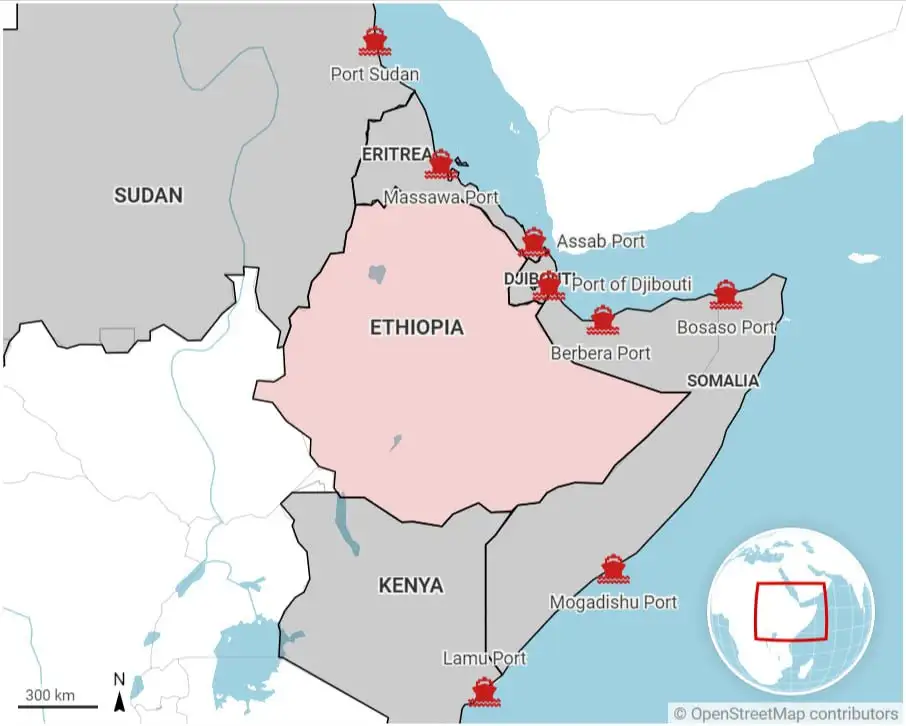
Ethiopia has spent the past week making its case for Red Sea access in the language of regional growth and long-term partnership. It is a reasonable, forward-looking case: 130 million people, one of Africa's fastest-growing economies, and no direct maritime outlet of its own, a geographic accident of history, not a reflection of Ethiopia's economic weight or its stabilizing role in the Horn of Africa. Yet the reaction from Ethiopia's neighbors this week reveals something less reasonable, a pattern of reflexive exclusion that has far more to do with old rivalries and outside patronage than with any principled reading of international law or regional interest.
Cairo and Asmara: an alliance built on shutting Ethiopia out, not on genuine Red Sea security
The most telling development came from Egypt and Eritrea. As Manassa News reported, the two countries signed a maritime transport agreement in Asmara in May, launching a joint cargo route between their Red Sea ports. On its face, a trade deal. But the two governments used the occasion to declare that Red Sea governance and security should remain the exclusive preserve of littoral states, a formulation designed for one purpose. That is to write Ethiopia, Africa's second-most populous nation, out of any say over a waterway central to its economic future.
This is not a neutral legal position. It is Cairo importing its decades-long dispute with Addis Ababa over the Nile into an entirely separate question of maritime access, using Eritrea as a convenient partner of grievance. As Al-Monitor detailed, Ethiopia's foreign ministry was right to call this out directly, accusing Egypt of trying to obstruct Ethiopia's legitimate Red Sea ambitions within days of the Asmara agreement being signed on an accusation Cairo has still not meaningfully answered.
Eritrea's "red line" rhetoric is not principle, it is old grievance dressed up as sovereignty
Asmara's language has only hardened. Per the Bloomsbury Intelligence and Security Institute, Eritrea has rejected Ethiopia's concerns about TPLF collaboration and has cast any Ethiopian pursuit of sea access as a "red line". The kind of maximalist framing that forecloses dialogue before it can begin. Eritrea's information minister went further, as Al Jazeera reported, dismissing Ethiopia's ambitions as misguided regardless of whether Addis pursues them through diplomacy or force, and calling on the international community to pressure Ethiopia rather than engage it.
It is worth naming what this rhetoric actually protects, not Eritrean sovereignty, which Ethiopia has never disputed, but Eritrea's ability to hold hostage a landlocked neighbor's basic economic lifeline over a border dispute more than three decades old.
Somalia's blanket refusal ignores the moderate substance of Ethiopia's ask
Somalia's position, unchanged since the 2024 Somaliland memorandum, remains the most rigid. As IntelliNews reported, Somalia's State Minister of Foreign Affairs rejected Ethiopian requests for port-access negotiations outright, framing any discussion as a threat to constitutional sovereignty. But this conflates two very different things; a negotiated commercial arrangement, of the kind nations strike over ports worldwide, with an existential threat to Somali territory. Ethiopia has repeatedly said it seeks access through peaceful, negotiated means. Treating that request as categorically illegitimate serves Mogadishu's domestic politics more than it serves regional stability.
Djibouti's silence is not neutrality, it is a hedge toward Europe
Djibouti's position deserves particular scrutiny, because it is so often mistaken for even-handedness. As a Horn Review analysis noted, Djibouti draws roughly 90 percent of its port revenue from Ethiopian transit meaning its own prosperity is bound to Ethiopia's economic access far more than to any Egyptian-Eritrean axis. Yet Djibouti was conspicuously absent from the recent Egypt-Eritrea-Somalia engagement, an absence the same analysis attributes not to loyalty to Addis Ababa but to a quiet pivot toward the European Union, formalized through a Status of Forces Agreement signed in July covering EU naval operations along the Djiboutian coast. Djibouti, in other words, is hedging toward Brussels while continuing to profit from Addis Ababa, a posture that should be called what it is, rather than mistaken for genuine partnership.
The African Union's silence is itself telling
Perhaps most striking is what has not been said. Despite hosting the AU's headquarters and having convened Horn of Africa mediation efforts for decades, the African Union Commission has offered no fresh, on-record statement addressing Ethiopia's renewed and entirely peaceful case for Red Sea access this week. For a continental body founded on principles of shared prosperity and regional integration, that silence in the face of a member state's legitimate economic appeal is difficult to justify and Ethiopian diplomacy would be well served by pressing the AU to engage on the substance rather than allow the issue to be defined solely by the loudest rejectionist voices in the neighborhood.
The bigger picture
What unites Egypt, Eritrea, Somalia and, more quietly, Djibouti this week is not principle but self-interest dressed as sovereignty, old rivalries, outside alignments, and a reluctance to treat Ethiopia's economic future as a legitimate regional concern rather than a threat to be contained. Ethiopia has consistently framed its case in terms of shared growth, peaceful negotiation, and regional integration. Its neighbors, this week, answered with rejection rather than dialogue. That imbalance, a reasonable request met with a closed door is the part of the story Ethiopian audiences deserve to see clearly.
Sources: Manassa News, Al-Monitor, Bloomsbury Intelligence and Security Institute (BISI), Al Jazeera, bne IntelliNews, Horn Review.